Friday, January 30, 2026

Atlanta child molester sentenced for illegally possessing firearm while impersonating a police officer

ATLANTA – Fredrick Crawford, a convicted child molester, robber, and stalker, has been sentenced to prison for unlawfully possessing a firearm at an Atlanta gas station where he was impersonating a police officer and threatening customers.

"If a real officer had not caught this armed felon pretending to be a cop, someone could have been seriously injured,” said U.S. Attorney Theodore S. Hertzberg. “Thanks to my office’s close partnership with the Atlanta Police Department, which referred this case for federal prosecution, the community is safer because Crawford is back in prison, where he belongs.”

“Impersonating a law enforcement officer is a serious crime that undermines public trust and safety. Fredrick Crawford’s actions not only endangered the lives of innocent citizens but also posed a significant risk to legitimate law enforcement efforts. The ATF is committed to working alongside our partners to ensure that individuals who engage in such reckless behavior are held accountable,” said ATF Assistant Special Agent in Charge Ryan Todd.

“This case underscores the vigilance and professionalism of our officers, even when off duty,” said Atlanta Police Chief Darin Schierbaum. “An armed felon impersonating a police officer poses a grave threat to public safety and to the integrity of law enforcement. Thanks to the quick actions of our sergeant and the coordinated response that followed, a dangerous individual was taken off the streets.”

According to U.S. Attorney Hertzberg, the charges and other information presented in court: On April 12, 2024, an off-duty Atlanta Police Department (APD) sergeant who was buying fuel at a gas station saw Fredrick Crawford, who was armed and wearing a uniform labeled “Fugitive Task Force.” Crawford was arguing with customers, claimed he was a police officer, and repeatedly threatened to issue tickets to people at the gas station.

Concerned by Crawford’s behavior, the sergeant approached him. As their conversation unfolded, the sergeant began to suspect that Crawford was not a real police officer. The sergeant flagged down two marked APD vehicles. When Crawford saw the other officers approaching, he fled and tossed his firearm.

When Crawford was apprehended, officers discovered he was a previously convicted felon and prohibited from possessing a firearm. Along with a prior conviction for possession of a firearm by a convicted felon, Crawford also had previous criminal convictions for child molestation, family violence battery, aggravated stalking, and robbery by force. Initially, Crawford was prosecuted in Fulton County, where the district attorney’s office recommended a sentence of just nine months of imprisonment. To achieve more appropriate punishment for this violent recidivist, the Atlanta Police Department requested successive prosecution of Crawford in federal court.

Fredrick Crawford, 34, of Atlanta, Georgia, was sentenced by U.S. District Judge Mark H. Cohen to four years in federal prison, to be followed by three years of supervised release.

This case was investigated by the Bureau of Alcohol, Tobacco, Firearms and Explosives, with assistance from the Atlanta Police Department. 

Assistant U.S. Attorneys Nicholas L. Evert and Chloe Cobb Smith prosecuted the case.

This case is part of Operation Take Back America, a nationwide initiative that marshals the full resources of the Department of Justice to repel the invasion of illegal immigration, achieve the total elimination of cartels and transnational criminal organizations, and protect our communities from the perpetrators of violent crime.

For further information please contact the U.S. Attorney’s Public Affairs Office at USAGAN.PressEmails@usdoj.gov or (404) 581-6016. The Internet address for the U.S. Attorney’s Office for the Northern District of Georgia is http://www.justice.gov/usao-ndga.

Saturday, January 17, 2026

From Kent State to Santa Ana: The Impossible Mission of Policing Protest in a Free Society

On May 4, 1970, Ohio National Guard soldiers fired into a crowd of student demonstrators at Kent State University, killing four and wounding nine. The nation recoiled in horror. The lesson seemed unmistakable: when government meets dissent with bullets, legitimacy collapses.

Yet the deeper lesson was more complicated. Kent State was not simply a story of brutality. It was also a story of fear, confusion, command breakdown, and crowd volatility. Guardsmen faced a hostile environment, property damage, and swelling tension. None of this justified the gunfire — but it revealed something enduring: mass protest is one of the most unstable environments any government can face.

The tragedy forced a national reckoning. Law enforcement did not ignore it. Agencies across the country sought better ways — ways to control disorder without killing. The goal was not repression, but restraint.

What followed was not stagnation, but evolution.


The 1970s–1990s: The search for restraint

After the upheavals of the late 1960s and early 1970s, police departments began formalizing crowd-control doctrine. Riot formations replaced ad hoc responses. Tear gas replaced batons and rifles. The idea was to create distance between officers and crowds and to disperse disorder without deadly force.

But just months after Kent State, the limits of this approach became tragically clear.

During the 1970 Chicano Moratorium in East Los Angeles, journalist Rubén Salazar was killed when a sheriff’s deputy fired a tear-gas projectile into a crowded café. This was not battlefield gunfire. It was the new restrained model of crowd control — and it still proved lethal.

Here lies the first great warning: changing tools does not change physics. High-velocity projectiles, even when labeled “crowd control,” remain dangerous when deployed in dense, chaotic environments.

Police were not ignoring public concern — they were trying to adapt. But adaptation did not eliminate risk; it narrowed the margin for error.


The 1990s–2000s: Less-lethal becomes standard

By the 1990s and early 2000s, American policing increasingly adopted rubber bullets, foam baton rounds, beanbags, and pepperball systems. These tools were designed precisely because firearms were unacceptable for crowd management in a democratic society.

Their intent was humane.

Yet incidents such as the 2007 MacArthur Park protests in Los Angeles revealed a recurring dilemma. Protesters who refused dispersal orders, surged police lines, or threw objects created conditions in which officers had seconds to act. Area weapons were used because individualized targeting was impossible.

Injury followed — not because restraint was abandoned, but because crowd control itself is structurally imprecise.

This period illustrates an important truth often ignored in modern debate: police reform has been continuous for fifty years. The profession has not been static or indifferent. It has been struggling with an inherently unsolvable equation.


2020: A nationwide stress test

The George Floyd protests in 2020 became the largest test of modern crowd-control doctrine in American history. Millions protested peacefully. Some protests, however, turned violent, with arson, assaults, and mass disorder.

Police faced simultaneous, contradictory expectations:

  • Protect lives and property

  • Preserve First Amendment freedoms

  • Avoid deadly force

  • Restore order quickly

No doctrine can perfectly satisfy all four.

Officers used shields, chemical agents, and impact munitions — tools developed precisely to avoid Kent State–style outcomes. Yet serious injuries still occurred.

The lesson was sobering: even reformed policing methods fail under the pressure of mass unrest.


2026: Santa Ana and the modern dilemma

In January 2026, federal agents responding to an anti-ICE protest in Santa Ana used less-lethal munitions that blinded demonstrators struck in the face.

These injuries are morally serious. But they occurred in a familiar operational reality:

  • rapidly shifting crowds

  • compressed reaction time

  • objects thrown from within the mass

  • blurred lines between peaceful protesters and agitators

Police officers cannot freeze a crowd and conduct courtroom-level analysis. They must decide in seconds.

Protest tactics shape this environment. When demonstrators ignore dispersal orders, block emergency routes, mask identities, and surge lines, they make individualized enforcement nearly impossible. Officers then resort to area-control tools — and area tools inevitably harm indiscriminately.

This is not because police abandon professionalism. It is because the mission itself becomes physically unmanageable.


The central tragedy of democratic policing

Authoritarian states solve this easily. They ban protest. They crush crowds early. Their police face fewer dilemmas because liberty has already been surrendered.

Free societies choose the harder path.

We protect:

  • mass assembly

  • disruptive speech

  • emotional dissent

And we simultaneously demand public safety.

This creates an impossible assignment:

  • Maintain order without suppressing liberty;
  • Use force without destroying legitimacy; and, 
  • Act decisively without acting indiscriminately.

No tactic perfectly satisfies all three.

This is why each generation experiences a different version of the same tragedy:

EraToolOutcome
1970             Rifles        Death
1970            Tear-gas projectile        Death
2007            Foam rounds        Serious injury
2020            Impact munitions        Widespread trauma
2026            Less-lethal rounds        Permanent blindness

The tools evolve. The tension remains.


Why this is not a story of bad faith

It is tempting to reduce these events to villainy. But history tells a more difficult truth.

American policing has spent half a century trying to become more restrained, more professional, more constitutional. Each reform narrows the margin of harm — but cannot eliminate it.

This is not evidence of moral failure. It is evidence of democratic physics.

Crowds are volatile.
Protests are unpredictable.
Force is never precise.

Police stand at the fault line between liberty and order — asked to hold both simultaneously.


The uncomfortable reality

Kent State teaches that force can be too heavy.
Salazar teaches that restraint can still misfire.
Santa Ana teaches that even modern reform leaves irreversible harm.

This does not mean law enforcement is unjust.

It means that policing protest in a free society is one of the hardest missions any government can assign.

Liberty generates disorder.
Order requires coercion.
And between them stands the officer — expected to solve an unsolvable problem in seconds.

That is not a moral failure of policing.

It is the tragic cost of freedom itself.

Friday, January 16, 2026

$5,000 Reward Offered for Information Regarding Blue Ash Carjacking

CINCINNATI — The Bureau of Alcohol, Tobacco, Firearms and Explosives (ATF) is offering a reward for information leading to the identification, arrest, and conviction of the individual or individuals responsible for a carjacking in Blue Ash.

According to the Blue Ash Police Department, officers responded to the 3800 block of Bellview Avenue on December 12, 2025, following a report of a carjacking. The victim told police the suspect brandished a firearm and stole the vehicle, constituting an aggravated robbery.

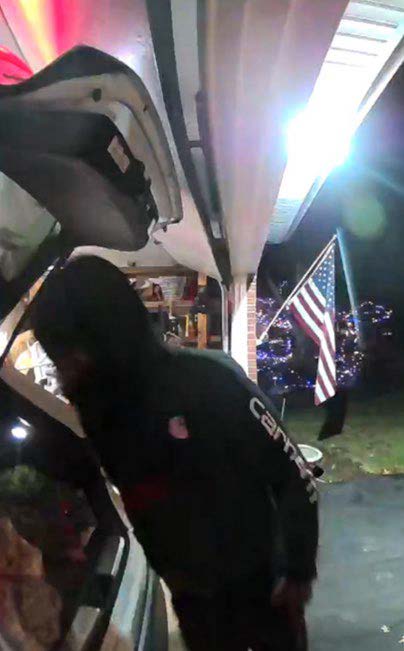
Blue Ash carjacking suspect looking in the open trunk of the carjacked vehicle.

Blue Ash carjacking suspect looking in the open trunk of the carjacked vehicle.

The stolen vehicle was later recovered on Yearling Court in Cincinnati.

ATF has partnered with the Blue Ash Police Department and has joined the investigation in search of those responsible. As part of that effort, ATF is offering a reward of up to $5,000 for information related to the case.

Anyone who has information about this incident should contact ATF at 1-888-ATF-TIPS (888-283-8477). Individuals may also email ATFTips@atf.gov 

r contact ATF through its website at www.atf.gov/contact/atf-tips. Tips may also be submitted to ATF using the ReportIt® app, available on both Google Play and the Apple App Store, or by visiting www.reportit.com.

Tips can also be submitted to the Blue Ash Police Department at 513-745-8555 or Cincinnati Crimestoppers at 513-352-3040.