Friday, August 29, 2025

Defense Secretary Honors Tennessee Police Department During Award Ceremony

Defense Secretary Pete Hegseth honored a local police department today for being a recipient of the 2025 Employer Support of the Guard and Reserve Secretary of Defense Employer Support Freedom Award during a city hall ceremony in Hendersonville, Tennessee.

Originally announced July 7, 2025, the Hendersonville Police Department was one of 15 organizations to receive the coveted Freedom Award, the highest U.S. government honor presented to employers for supporting military reserve component employees.  

Hegseth, a former National Guardsman who has ties to Tennessee, spoke highly of the ESGR and said he was honored to make the trip from Washington to present the award. 

"This place means a lot to me; what these men and women do means a lot to me; [and] what ESGR does means a lot to me," Hegseth said.  

He went on to explain that he wishes every child in America could see and interact with those who serve in order to counter the more superficial "celebrity clickbait culture" that he sees as being pervasive in our society.  

"If you want to look for heroes … just look around this room," Hegseth told those in attendance, noting that the manner in which they respond to unknown daily contingencies is demonstrative of their heroism.
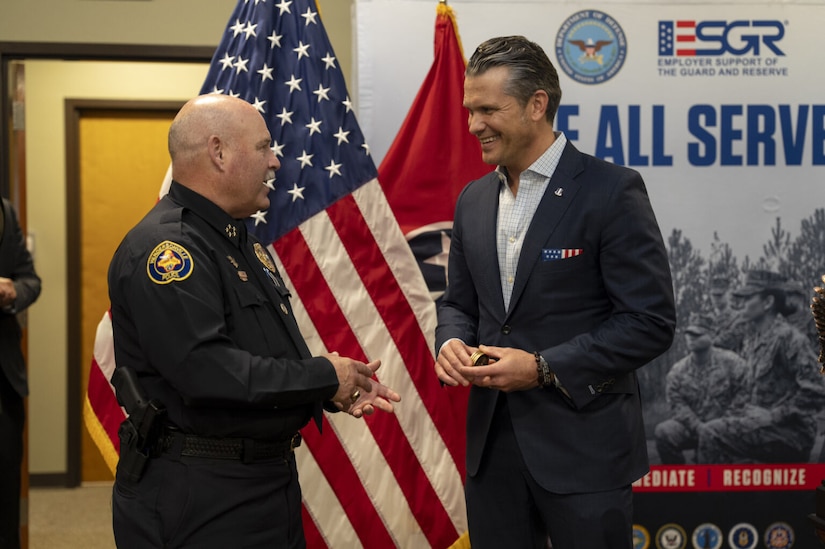
Two men, one in a police officer’s uniform and the other in civilian business attire, are talking. There is a U.S. flag behind them.

Hegseth went on to commend the department's 15 reserve component service members for choosing to serve part time in the military in addition to their already hazardous full-time jobs. 

"That's the bedrock of what a country is built on; that's how you know that you're not just free, but you live free because you're committed to the very service at a baseline level," he said.  

The secretary also assured the department employees that, just as the Hendersonville Police Department has their backs, so does the entire chain of command, including President Donald J. Trump. 

"If the top has your back, as President Trump does, or if the secretary of defense has your back, or the attorney general … that means you can go out — step out on a difficult issue, whatever it is — and do your job the right way, and execute knowing you have that support," Hegseth said, also noting that ESGR supports the service members and their families at a macro level.  

Hegseth wound down his remarks by once again thanking the police department for supporting the part-time service members.
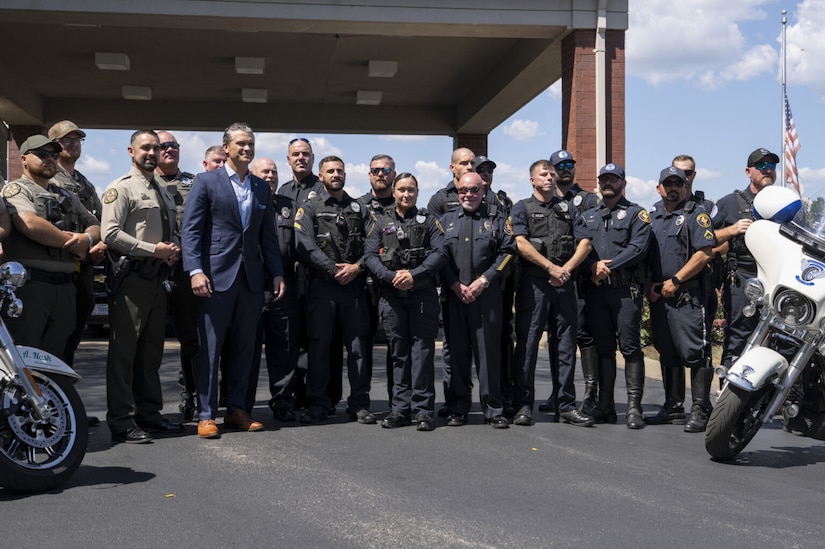
A man in civilian business attire stands amid roughly 20 men in police officer uniforms. They are flanked on either side by a pair of police motorcycles.


"Thanks for what you do with this community [and] for your willingness to let [the service member employees] go elsewhere, to serve the country as well," he said. 

"It's our job to make sure they're well served by the plans we give them, and the missions we give them, and [that we] bring them home safe," he added.  

ESGR began the Freedom Award program in 1996 to recognize exceptional employer support, with 370 honorees to date. 

In addition to the Hendersonville Police Department, the following 14 organizations also received the award in 2025: 

  • Cox Enterprises; Atlanta  
  • GE Aerospace; West Chester, Ohio  
  • GM Financial; Fort Worth, Texas  
  • Honeywell; Minneapolis 
  • Kimberly-Clark Corporation; Neenah, Wisconsin 
  • Anchorage Fire Department; Anchorage, Alaska 
  • Coppell Independent School District; Coppell, Texas 
  • Metropolitan Airports Commission; Minneapolis 
  • Mike Monroney; Oklahoma City 
  • Air Aviation; Allen, Texas 
  • Art C. Klein Construction Inc.; Colorado Springs, Colorado 
  • Boyd Jones; Omaha, Nebraska 
  • Graham Construction; Des Moines, Iowa 
  • MI Technical Solutions; Chesapeake, Virginia

Tuesday, August 26, 2025

DOD Systems Bolster Border Security Operations


Aug. 25, 2025 | 

By Army Pfc. Dominic Atlas, Joint Task Force Southern Border |

Along the rugged terrain of the southern border, the Defense Department deploys optic systems to enhance detection and monitoring capabilities in support of U.S. Customs and Border Protection.

The ground-based operational surveillance system — expeditionary, the long-range advanced scout surveillance system, and the common remotely operated weapon station are advanced tools and unique military capabilities used by service members assigned to Joint Task Force Southern Border to monitor large areas, detect illegal crossings and strengthen perimeter security in coordination with CBP agents.

Whether elevated on towers, deployed from concealed positions or mounted on armored vehicles, these systems provide persistent coverage across challenging and often inaccessible landscapes. Each platform offers a unique capability, contributing to the multilayered detection and monitoring strategy in place along the southern border.

Elevated Overwatch and Area Monitoring

The ground-based operational surveillance system — expeditionary, is an advanced fixed-position monitoring asset. Mounted on telescoping masts or permanent towers, GBOSS-E integrates electro-optical and infrared cameras, laser rangefinders and ground radar to enable nonstop observation across large sectors of terrain.

From its elevated position, the system allows operators to detect, identify and geolocate movement in open desert and rugged terrain — critical for tracking groups attempting to cross into the U.S. without authorization. What makes the system unique is that it is an organic asset to military police units. 

By employing it in this mission, soldiers are not only enhancing border security but also building readiness by training with and refining the use of their equipment in a real-world environment.

"Integrating the GBOSS-E system into our mission set has enhanced our soldiers' ability to detect threats from a distance. These systems allow our soldiers to pick up on movement and heat signatures through radar and camera capabilities that enhance monitoring efforts, especially at night and from a distance," said Army Sgt. 1st Class Sean Marshall, Headquarters and Headquarters Detachment, 759th Military Police Battalion. "In an austere environment like Yuma, [Arizona,] where the desert extends for miles, the GBOSS-E is a force multiplier that enables us to use the terrain to our advantage."

Long-Range Target Detection From Concealed Positions

The long-range advanced scout surveillance system provides high-fidelity visual monitoring and long-range target detection from mobile platforms such as the Stryker armored vehicle. By combining thermal imaging, day cameras, GPS, and a laser rangefinder, LRAS3 enables soldiers to observe and identify subjects from several kilometers away while remaining protected under armor and out of sight.

Originally designed as a cavalry asset for reconnaissance teams in forward-deployed environments, the LRAS3 has been in use for decades. With the integration of cavalry elements into infantry formations, the system has transitioned from a specialized tool to one now available at the company level. 

Along the southern border, LRAS3 has found a new purpose, providing personnel with long-range detection capabilities to discreetly monitor trails, canyons and key terrain features from standoff positions. Repurposed for homeland security, the system continues to prove its value by supporting CBP operations.

"This system allows a Stryker with a mounted LRAS3 to provide U.S. Border Patrol with the information and location needed to interdict suspected illegal aliens," said Army 1st Lt. Elias Stephenson, 2nd Battalion, 12th Infantry Regiment, 2nd Brigade Combat Team, 4th Infantry Division. "It's used in areas that have substantial observation capabilities to support the detection capabilities of the system and enable U.S. Border Patrol interdiction."

Remote Observation With Defensive Capability

The common remotely operated weapon station provides operators with long-range observation capabilities. Mounted on Stryker armored vehicles, CROWS allows soldiers to detect and track activity while remaining protected inside the vehicle.

Equipped with stabilized optics, thermal and day cameras and a laser rangefinder, the system is now employed along the southern border strictly as a detection and monitoring asset. 


Originally designed to integrate with crew-served weapons in combat zones, the system has been repurposed for homeland security missions to provide personnel with long-range observation capability without its traditional armament. This adaptation highlights its versatility — enabling soldiers and Department of Homeland Security personnel to maintain persistent watch over high-risk border sectors while remaining protected inside their vehicles.

The common remotely operated weapon station is a remote camera system on the Stryker that is normally used for the Stryker's mounted machine gun for targeting in combat. 

"For the southern border mission, we don't have weapons mounted. So, it's been repurposed to extend our duration for detection and monitoring capabilities. This allows our vehicle commanders to detect individuals at greater distances and enable border apprehensions," Stephenson said.

Integrated Systems, Unified Mission

Together, GBOSS-E, LRAS3 and CROWS demonstrate the unique military capabilities that DOD contributes to border security operations. By combining advanced surveillance platforms, specialized training and the ability to operate in austere environments, these systems strengthen detection and monitoring efforts across the southern border. 

Their integration also reflects the close partnership between DOD and DHS in protecting national sovereignty and disrupting illicit activity.

As the mission continues, these systems remain vital to detecting movement, monitoring critical areas and supporting soldiers and law enforcement personnel working together to secure the southern border, Stephenson said.

Friday, August 22, 2025

Send Clinicians, Not Cops? Inside Denver’s STAR

In response to the increasing frequency of mental health crises and nonviolent emergencies, many U.S. cities have launched initiatives to divert certain emergency calls away from law enforcement. Denver’s Support Team Assisted Response (STAR) program is at the forefront of this movement. Staffing clinically trained behavioral health professionals alongside paramedics, STAR addresses mental health, homelessness, poverty, and substance use crises with a trauma-informed, community-centered approach. This essay explores STAR’s inception, operations, outcomes, challenges, and broader implications as an alternative to traditional policing in emergency response.

Origins and Development of STAR

Denver’s STAR program was launched in June 2020, modeled on the successful CAHOOTS initiative in Eugene, Oregon. The pilot was funded by the Caring for Denver Foundation and supported by partnerships between Denver’s Department of Public Health and Environment, Denver Health, WellPower, and Denver 911. The goal was to create a third pathway—beyond police and conventional EMS—for responding to low-risk behavioral health and social distress calls.

During its initial six-month pilot, responding to roughly 748 calls, the program showed early promise: no arrests, no police backup, and a potential reduction of about 2.8% in police service calls. Encouraged by these early results, STAR expanded operational capacity, staff, and geographic reach.

How STAR Operates

STAR teams consist of a behavioral health clinician paired with an EMT or paramedic, operating in unmarked vehicles and plain clothes to reduce stigma and perceived threat. Dispatchers screen incoming 911 calls and divert appropriate "STAR-eligible" cases to this alternative response team.

As of February 2024, STAR staff included 16 clinicians and 16 EMTs/paramedics, operating eight vans. The program runs daily from 6 a.m. to 10 p.m., with expansion toward 24/7 coverage anticipated by 2025. STAR addresses a spectrum of needs—mental health triage, de-escalation, transportation to care, and resource connection. In early years, around 41% of individuals were referred to formal treatment, and 38% were transported to community services.

Program Scale & Evolving Impact

By 2025, STAR had logged over 14,000 encounters and served more than 8,500 individuals. Of the approximately 12,000 clinical contacts recorded between June 2020 and December 2024, only 3% resulted in a mandatory psychiatric hold. In contrast, roughly 30% triggered transport and linkage to services, and about 50% resulted in referrals to community-based care.

Moreover, between June 1, 2020, and June 3, 2025, STAR responded to 25,144 incidents, signaling substantial integration into Denver’s 911 system.

Community and System Benefits

STAR’s benefits span multiple domains:

  1. Diverting Vulnerable Populations from Criminal Justice
    STAR’s clinical teams can de-escalate situations without criminalization—minimizing police involvement, jail risk, and other adverse outcomes.

  2. Operational Efficiency for First Responders
    City officials note that redirecting low-risk behavioral health calls to STAR frees law enforcement, EMS, and firefighters to focus on high-acuity emergencies.

  3. Criminal Justice Outcomes
    A Stanford-led study found a 34% decrease in low-level criminal offenses in neighborhoods served by STAR during its pilot, equivalent to roughly 1,400 fewer reported offenses.

  4. Innovation Model for Other Cities
    Denver positions STAR as a national exemplar. Surveys found consensus that “sending police to deal with every social problem simply isn’t working.” The program exemplifies creative, multi-stakeholder public safety innovation.

Challenges and Limitations

Despite its successes, STAR faces notable challenges:

  • Limited Hours and Funding Constraints
    Operating only from 6 a.m. to 10 p.m., STAR lacks full 24/7 availability due to funding limitations. Denver’s STAR budget was around $7.2 million, including city and grant support. Expansion would require additional investment.

  • Dispatcher Reliance and Call Screening
    Effectiveness depends on accurate triage by 911 dispatchers—misclassification can lead to safety issues or mismatches in response.

  • Need for Community Involvement
    Some community advocates question the pace and transparency of STAR’s expansion, advocating for stronger public input via advisory boards. Denver is now moving to formalize such bodies.

Broader Context and Replication

Denver is part of a broader trend toward non-police crisis response. Cities like New York (B-HEARD), San Francisco, Minneapolis, and others are piloting or expanding similar models, often inspired by CAHOOTS and STAR. Yet challenges with staffing, funding, and dispatcher workflows persist.

STAR’s success illustrates the effectiveness of a clinical, de-escalating approach—particularly in a time where overreliance on policing is increasingly scrutinized.

Conclusion

Denver’s Support Team Assisted Response (STAR) program represents a bold reimagining of first response—substituting clinicians and EMTs for police in low-risk behavioral health and social emergencies. Since its 2020 launch, STAR has expanded significantly, delivering over 25,000 responses, reducing crime, and fostering community trust. Its low psychiatric hold rate and high referral rate speak to the success of trauma-informed crisis intervention. Yet continued impact depends on extending operating hours, securing sustainable funding, and deepening community engagement. As more cities look to follow in its footsteps, STAR stands as both a model—and a work in progress—in the shift from law enforcement to healthcare-based emergency support.


References 

Denver Department of Public Health & Environment. (2024, February). Support Team Assisted Response (STAR) Program [Website]. Retrieved from Denver official site

Gillespie, S., Curran‑Groome, W., & Rogin, A. (2024, September 30). Evaluating alternative crisis response in Denver’s Support Team Assisted Response (STAR) program: Interim findings [Brief]. Urban Institute.

WellPower. (2025, June 25). Denver’s STAR Program: Five years of community impact [Blog post]. Retrieved from WellPower website

Stanford study as cited by Axios. (2022, June 22). Study: Denver’s STAR police‑alternative program lowered crime and costs [News article]. Axios.

Axios. (2025, June 9). What’s next for the police response alternative STAR as it turns 5 [News article]. Axios.