Sunday, September 28, 2025

The Thin Blue Line and Mental Health: Breaking the Silence Within the Ranks

The phrase “the thin blue line” has long symbolized solidarity among police officers and the role they play as society’s barrier between order and chaos. It represents loyalty, bravery, and mutual protection within the profession. Yet the same culture that builds unity often cultivates silence when it comes to mental health. Law enforcement is among the most psychologically demanding professions in modern society, marked by trauma, danger, and long-term stress exposure. Despite this, officers historically have faced stigma when acknowledging psychological struggles, leading many to suffer quietly rather than seek help.

In recent years, increasing awareness of officer suicides, depression, and post-traumatic stress disorder (PTSD) has forced policing institutions to confront the mental health crisis within their own ranks. While progress has been made in developing peer support teams, embedding wellness professionals, and reducing stigma, barriers remain. To sustain effective policing and protect officers’ lives, the culture of silence must be broken. This essay examines the roots of that silence, the toll of unaddressed mental health issues, and emerging strategies to support wellness in law enforcement.


The Demands of the Job

Policing is inherently stressful. Officers work long, unpredictable hours, often rotating shifts that disrupt circadian rhythms and sleep quality. They are called to confront violent crimes, domestic disputes, fatal accidents, and disasters. At the same time, they must balance enforcement responsibilities with community service, sometimes under intense public scrutiny.

Physiologically, the job primes officers for hypervigilance. Daily exposure to threats keeps their nervous systems in a near-constant state of fight-or-flight. Research indicates that cumulative exposure to traumatic incidents contributes to burnout, anxiety, and substance misuse (Violanti, 2018). Unlike singular catastrophic events, repeated lower-level exposures—such as responding to child abuse, suicides, or vehicle fatalities—accumulate over time, eroding psychological resilience.

This strain is exacerbated by the public’s evolving expectations. In many communities, officers are expected to act as first responders not only to crime but also to mental health crises, homelessness, and substance abuse. The gap between resources and responsibilities adds to the burden, heightening stress and frustration (Police Executive Research Forum [PERF], 2019).


The Culture of Silence

Policing culture has historically emphasized toughness, stoicism, and self-reliance. Officers are trained to project control and composure, even in life-threatening situations. While these traits serve operational effectiveness, they create obstacles when officers experience psychological distress.

Within many departments, seeking help has been equated with weakness or perceived as career-threatening. Officers may fear losing firearm privileges, being passed over for promotions, or being ostracized by peers. This culture of silence reinforces the thin blue line as a barrier not only between police and society but also between officers and the resources they need.

This paradox is stark: while officers rely heavily on one another for physical survival, they are less inclined to extend that solidarity to mental health. Instead, the ethos of “suck it up and move on” prevails. Although awareness is growing, surveys consistently find that stigma remains a major barrier to treatment (International Association of Chiefs of Police [IACP], 2020).


The Toll: Statistics and Human Cost

The consequences of silence are profound. Studies consistently show that law enforcement officers experience higher rates of depression, PTSD, and substance use than the general population (Violanti, 2018). Badge of Life, a police mental health advocacy organization, has reported that officers are at significantly greater risk of suicide than line-of-duty deaths in many years (Badge of Life, 2021).

Estimates suggest that between 15–20% of officers exhibit PTSD symptoms, compared to around 7–8% of the general population (McCreary & Thompson, 2006). Alcohol misuse is another common coping mechanism, with prevalence higher among officers than civilians.

The toll extends to families. Spouses and children often bear the brunt of untreated mental health issues, facing strained relationships, isolation, and secondary trauma. Marital breakdown rates among officers exceed national averages, reflecting the cumulative stress carried home (NAMI, 2022).

Several high-profile officer suicides have drawn attention to this hidden crisis. These cases underscore the urgent need for systemic support, not only for individual officers but for their families and communities as well.


Breaking the Silence: Evolving Perspectives

Encouragingly, the culture of silence is beginning to shift. Law enforcement leaders, unions, and advocacy groups have increasingly recognized the urgency of addressing officer wellness. Chiefs across the country have endorsed wellness programs, and federal funding has supported initiatives to embed mental health professionals within departments (IACP, 2020).

Peer support teams, which allow officers to confide in trained colleagues, have gained traction. These programs leverage trust and shared experience, reducing stigma and normalizing help-seeking behavior. Chaplaincy programs and confidential hotlines provide additional avenues for support.

Perhaps most importantly, officers themselves have begun to tell their stories publicly. From memoirs to department testimonials, firsthand accounts of depression, PTSD, and recovery have helped reframe vulnerability as strength. As one retired officer reflected, “If we don’t talk about it, we bury more cops.” The visibility of these stories contributes to cultural change, signaling that survival means more than making it through a shift—it means staying healthy throughout a career.


Programs and Best Practices

Departments across North America and beyond have piloted wellness initiatives with varying degrees of success. Key practices include:

  • Employee Assistance Programs (EAPs): Provide confidential counseling and referral services. While often underutilized, they serve as entry points for care.

  • Critical Incident Stress Debriefings: Mandated after shootings, mass casualties, or officer deaths, these sessions aim to process trauma in a structured environment.

  • Resiliency and Mindfulness Training: Programs such as yoga, meditation, and breathing exercises are increasingly offered, with evidence showing improvements in stress reduction (PERF, 2019).

  • International Comparisons: Canada has adopted national police wellness strategies, while the UK emphasizes trauma screening and peer mentoring. Australia has invested in psychological resilience training for recruits. These models highlight the global recognition of police mental health needs.

When programs are sustained and supported by leadership, outcomes improve: reduced absenteeism, fewer disciplinary issues, and improved morale (IACP, 2020).


Barriers that Remain

Despite progress, barriers persist. Stigma, though declining, still influences decisions. Officers may fear that using mental health services will affect promotions or reputation. Rural and smaller departments often lack resources to implement comprehensive wellness programs, leaving officers underserved.

Even when programs exist, they may be underfunded or poorly integrated into organizational culture. Officers sometimes distrust department-sponsored services, fearing breaches of confidentiality. Leadership buy-in remains uneven: some chiefs champion wellness, while others regard it as peripheral to mission readiness.

These gaps highlight the need for systemic change. Without consistent policy and funding, mental health support risks becoming optional rather than essential.


Policy and Leadership Recommendations

To embed wellness as a core component of policing, several steps are critical:

  1. Normalize Mental Health Check-Ups: Just as officers undergo regular physical exams, mandatory annual psychological screenings should become standard.

  2. Integrate Wellness into Training: Recruit academies should include resilience and stress management training, establishing healthy habits early.

  3. Federal and State Funding: Dedicated grants should support smaller agencies in developing wellness infrastructure.

  4. Leadership Accountability: Wellness literacy should be part of promotion criteria, ensuring leaders model and encourage mental health support.

  5. Partnerships: Collaboration with universities and nonprofits can bring evidence-based practices and evaluation into policing.

These recommendations aim not only to support officers individually but also to strengthen institutional resilience.


Reframing the Thin Blue Line

To truly break the silence, the symbolism of the thin blue line itself must evolve. Rather than functioning as a wall of stoicism, it can be reframed as a bond of mutual care. Officers already rely on each other for physical survival in dangerous situations; extending that solidarity to psychological survival is the next step.

Strength in policing should be defined not by suppressing vulnerability but by seeking help when needed. This reframing can enhance officer safety, improve community trust, and sustain careers. When wellness becomes a shared value, the thin blue line stands not only between society and disorder but also as a source of protection within the ranks.


Conclusion

The silence around mental health in law enforcement has exacted a heavy toll on officers, families, and communities. Yet silence is giving way to dialogue, and stigma is gradually eroding. Programs, peer support, and cultural shifts demonstrate that progress is possible.

Breaking the silence requires more than individual bravery; it demands systemic change, policy reform, and leadership commitment. Only then can the thin blue line represent not only loyalty and protection outwardly but also compassion and resilience inwardly. In doing so, law enforcement will honor its duty to protect and serve—beginning with its own.


References

Badge of Life. (2021). Annual police suicide report. Badge of Life.

International Association of Chiefs of Police. (2020). Officer wellness and resilience: Key recommendations. IACP.

McCreary, D. R., & Thompson, M. M. (2006). Development of a gender role strain scale: Implications for understanding stress in police officers. Psychology of Men & Masculinity, 7(2), 93–115.

National Alliance on Mental Illness. (2022). First responders and mental health. NAMI.

Police Executive Research Forum. (2019). An occupational risk: What every police agency should do to prevent suicide among its officers. PERF.

Violanti, J. M. (2018). Police suicide: Epidemiology and prevention. Charles C. Thomas.


Friday, September 26, 2025

Inside the World of Chemistry, Calculations, and Clandestine Labs

This is the eighth installment in a series of profiles featuring DEA special agents, diversion investigators, chemists, and more. Learn about the tough but fulfilling, fascinating, and vital work these DEA personnel do, as well as the many different ways to get involved in fighting drug misuse. For our eighth profile, we will be interviewing Senior Research Chemist Joe from the Special Operations Division.

What motivated you to join the DEA?

I began work in a small forensic lab in Fort Worth, Texas. While the work I was exposed to was interesting and diverse, I wanted to grow. A colleague shared an employment offer packet with the stylized lettering “DEA Forensic Chemist.” Upon reading it completely, I knew immediately that was a challenge I wanted. I asked friends around the law enforcement community about any details they might share and learned of a passionate and smart team. To this date, I still love the decision to pursue this career with DEA and I still believe it to be one of the most fulfilling opportunities available in forensics.

What does an average day as a senior research chemist look like for you?

An average day involves me providing chemistry support for drug investigations and intelligence. Chemistry support involves calculations, organic chemistry, assessing precursor viability, and analytical considerations at the lab. This ranges from phone calls, emails, meetings, and even responding to drug crime scenes, such as clandestine laboratories. Additionally, I keep current with the trends in drug manufacturing and smuggling, as well as the evolution of forensic chemistry technology through peer-reviewed scientific articles. As DEA’s mission is global, I do spend a considerable amount of time traveling both domestically and internationally to meet with or present to investigators and other forensic researchers.  

What has been your proudest moment as a senior research chemist thus far?

I’m quite proud of the collaborations that are ongoing with other research institutions. We carry a great many projects with universities and other federal laboratories, both domestic and foreign, that produce advancements in forensics, intelligence, as well as organic and analytical chemistry in peer-reviewed publications, posters, patents, and presentations. There’s a satisfaction that is gained from serving the public and a unique one to contribute to the body of science.

How can young people who wish to become a DEA senior research chemist best prepare themselves for the job?

There are prerequisites for the position of forensic chemists; however, the best preparation is mental. Be willing and eager to take on the most formidable, the most difficult, and the most ominous challenges in your professional career. It’s the culmination of your victories and lessons learned that make for an impactful career in public service. As a professional, learning is self-paced and requires discipline. Much can be learned, especially in Forensic Chemistry, by seeking these challenges directly.

The synthetic opioid fentanyl – often mixed into other drugs – is now responsible for tens of thousands of American deaths per year. How has the fentanyl epidemic changed your job?

The synthetic drug crisis owes its origin and duration to organic chemistry. The very same chemistry that can be altruistic is, in the wrong hands, for profit and peril. As such, DEA’s progressed to include more and more chemists in its day-to-day operations. This includes frequent input on policy, executive advisement, prosecution meetings, and certainly – public outreach. Given the very nature of the potency associated with novel synthetic opioids, forensic chemistry has had to adapt in many ways. Myself and my forensic chemist colleagues throughout the DEA lab system strive to provide the very best support and the most comprehensive analyses in support of investigations.

Wednesday, September 24, 2025

“Turning the Camera On”: Body-Worn Camera Compliance, Problems, and Paths Forward

Introduction: Why Compliance Matters

Body-worn cameras (BWCs) have become a cornerstone of modern policing. Communities expect them to deliver transparency after critical incidents, prosecutors rely on them to build and evaluate cases, and officers increasingly see them as a safeguard against false allegations. But the promise of body cameras is only realized when agencies consistently follow their own rules—when cameras are activated on time, kept on when required, and the footage is preserved and reviewed in a way that the public, the courts, and the rank-and-file understand and trust.

In practice, this is where many departments struggle. Recent events—from district-level audits to high-profile incidents captured (or not captured) on video—show that the gap between policy and practice persists. This essay synthesizes five current news cases and related policy developments, examines the most common compliance problems, and outlines solutions anchored in technology, training, supervision, and community transparency. Underneath all of it is a single, animating reason for compliance: public trust.

A Snapshot From Recent News

Philadelphia’s District-Level Audit

A new audit by Philadelphia’s Citizens Police Oversight Commission (CPOC) examined BWC usage in the 24th Police District. The Commission reported full compliance in only about half of the sampled encounters, highlighting issues such as delayed activation and inconsistent deactivation discipline. For a city that has made substantial investment in cameras and policy infrastructure, the finding is a stark reminder that adoption is not the same as adherence.

Policy Ambiguity and State-Level Rules: Rhode Island

In Rhode Island, statewide BWC rules set intentions but leave room for ambiguity in timelines and exceptions. Reporting has noted that, in practice, the promise of quick public release can bend under vague phrases such as disclosure “after substantial completion” of investigative steps—well-meaning language that can produce inconsistent compliance across agencies and cases. Separate reporting from the Providence press has also spotlighted real-world confusion about when officers may mute or deactivate cameras at the request of victims or witnesses, and how that intersects with the rights and expectations of others at the scene.

A Teachable Moment on the Sidewalk

A widely discussed arrest of a Rhode Island prosecutor—captured on officers’ BWCs—revealed, in part, how misunderstandings about policy can collide with public perception. Whatever the legal outcome, the episode underscored why clear, well-trained, and uniformly applied rules matter: cameras that are reliably on and governed by transparent policy reduce the space for claims, counterclaims, and loss of confidence.

Federal Enforcement Agencies in Flux

At the federal level, policies remain in motion. Immigration and Customs Enforcement (ICE) formally updated its BWC directive in 2025, aligning use with Department-wide guidance and describing where and how cameras are to be deployed. By contrast, ProPublica reported that the Drug Enforcement Administration (DEA) terminated its body-camera program earlier in 2025, only a few years after it began. The divergence shows how mission demands, legal environments, and resource calculus can lead federal agencies down different paths—creating a patchwork that local communities must make sense of when federal and local operations overlap.

Oversight and the Learning Loop

Philadelphia again offers a useful lens: public release of audit findings—and the news coverage that follows—creates an accountability loop. Even when compliance is imperfect, transparent audits give agencies something precious: a baseline, a set of specific failure modes to attack, and a public conversation rooted in evidence rather than rumor. In this sense, measurable compliance is not merely a destination; it’s a continuous learning process.

The Most Common Compliance Problems

  1. Late Activation / Early Deactivation
    The single most frequent failure mode is simple: cameras that are not recording when they should be. Officers may forget to activate under stress, may miss transitions (for example, from a casual contact to a detention), or may deactivate too soon. The result is “holes” in the evidentiary record and, more damaging, the perception of selective recording.

  2. Policy Ambiguity and “Edge-Case” Exceptions
    Many policies attempt to balance transparency with privacy and officer safety—creating exceptions for victims, sensitive locations (schools, hospitals), confidential informants, or tactical operations. If these exceptions are not tightly defined, they become loopholes or points of confusion, leading to uneven compliance and post-incident disputes.

  3. Technical and Logistical Breakdowns
    Battery life, firmware bugs, failing mounts, storage bottlenecks, and upload delays undermine otherwise strong policies. If officers cannot trust the equipment to work—or if the video routinely “lags” before it can be reviewed—compliance erodes.

  4. Cultural Resistance or “Check-the-Box” Usage
    BWCs demand changes in habit. Where leadership does not model and reinforce why cameras matter—to officers as much as to the public—usage can become performative, inconsistent, or quietly adversarial. Even good officers may lapse if they do not see compliance as part of professional identity.

  5. Data Management, Redaction, and Discovery
    Capturing is only step one. Storing, tagging, redacting, and producing video that meets legal deadlines is hard and expensive. Agencies that under-resource these back-end functions can find themselves out of compliance even if officers press “record” every time.

  6. Public Release Policies That Invite Delay
    Good-faith investigative needs must be balanced against the public’s right to timely information. Policies that guarantee “eventual” release but lack clear timelines can erode public trust and make compliance appear discretionary.

Why Compliance Is Worth the Work

  • Public Trust and Legitimacy
    Consistent camera use and credible release practices demonstrate the agency is serious about transparency. Even difficult footage can build trust when the community sees that policy—not public pressure—drives disclosure.

  • Officer Protection and Fairness
    Many officers have been cleared or quickly exonerated because cameras recorded the full encounter. Compliance is a shield against false claims and a tool to coach better tactics.

  • Evidentiary Value and Case Integrity
    Prosecutors, juries, and judges increasingly expect high-quality video evidence. Incomplete recordings complicate prosecutions and can sink otherwise solid cases.

  • Organizational Learning and Training
    Supervisors and trainers can use footage to identify patterns and improve decision-making under stress. Cameras become a mirror for the organization, not just a window for the public.

  • Complaint Reduction and Better Interactions
    A growing (though not universal) research base suggests that reliable camera use can reduce citizen complaints and sometimes force incidents, likely by moderating behavior on both sides of the lens.

Solutions That Work (When Implemented Together)

  1. Precision Policies with Plain-English Triggers
    Policies should leave minimal room for subjective interpretation about when to record. A best-practice approach is to identify clear, observable triggers: any stop, frisk, search, arrest, transport, consent request, use of force, or interaction that has the potential to become enforcement-related. Deactivation rules should be equally explicit, with a short verbal announcement recorded on camera to mark the reason.

  2. Automatic Activation (“If This, Then Record”)
    Technology can offset human fallibility. Agencies increasingly pair cameras with “event triggers” that auto-activate recording when a cruiser’s light bar turns on, a firearm or Taser is unholstered, a patrol rifle leaves its rack, or a vehicle door opens during a stop. The closer activation is tied to observable events, the fewer missed recordings.

  3. Supervisory Audits and External Oversight
    Internal random audits—backed by clear corrective steps—keep usage from drifting. Independent oversight bodies, where authorized, add credibility and drive organizational learning by publishing findings that the public can understand.

  4. Training that Connects BWCs to Officer Interests
    Compliance improves when officers see cameras as tools for their safety and professionalism. Scenario-based training that shows how early activation avoids claims of “selective recording,” how video protects against false allegations, and how it informs better tactics builds buy-in.

  5. Resourced Data Management and Workflow
    Agencies need reliable upload stations, sufficient storage, effective search/tagging, robust redaction tools, and trained personnel to handle requests. Without this spine, compliance breaks down at the very moment footage is needed most.

  6. Time-Certain Release Policies with Safety Valves
    Where law allows, policies should aim for a default presumptive release after a fixed number of days in critical incidents, with narrowly drawn exceptions approved at the command level and documented in writing. Predictability—not speed alone—builds trust.

  7. Transparent Metrics and Public Dashboards
    What gets measured gets managed. Publishing basic compliance metrics (activation rates, average time to public release in critical incidents, audit findings, corrective actions) signals seriousness and creates a feedback loop for improvement.

  8. Union and Community Partnership
    Early, honest engagement with labor and community stakeholders reduces downstream conflict. When all parties help define the “rules of the road,” adherence improves.

Case-Anchored Lessons

  • Philadelphia’s Audit reminds us that measurement is the beginning of improvement. A 50-something percent compliance rate is not a verdict; it is a baseline. Agencies should celebrate the courage to measure publicly, then task command staff with driving compliance upwards quarter by quarter.

  • Rhode Island’s Policy Ambiguities show how imprecise timelines and exceptions can result in uneven compliance and confusion at the curbside. The remedy is not to abandon nuance but to tighten language, train against real-world edge cases, and publish examples of correct practice.

  • The Prosecutor’s Arrest illustrates why universal rules matter—for officials and citizens alike. Cameras that are on, with clear policy behind them, reduce the space for special pleading and restore focus to facts.

  • ICE and DEA Divergence demonstrates that mission sets matter. Even so, where agencies opt against cameras, they should provide robust alternate transparency measures; where they opt in, they should resource deployment fully and publish compliance metrics so the community knows whether policy is translating to practice.

Building a Culture of Compliance

All technology ultimately sits inside culture. The agencies that turn BWC systems into durable trust engines do it the same way they build tactical competence: through repetition, reinforcement, and leadership example. Field supervisors must check usage and correct lapses in near real-time. Commanders must talk about cameras not as “gotcha tools” but as instruments of professionalism. Policy shops must treat audits as a core function, not a once-a-year drill. And public information officers should normalize regular metrics reporting the way they report crime statistics.

The most important cultural insight is this: compliance is a craft skill. Officers can be taught to narrate key moments on camera for clarity (e.g., “Activating my camera as I approach the vehicle”; “Deactivating after the scene is secure and after explaining the reason”). Those small habits dramatically improve the evidentiary usefulness of footage and the public’s ability to understand what happened.

The Costs—and the Returns

Yes, cameras cost money. Storage, redaction, and discovery support cost money. Audits and oversight cost money. But the returns show up in better prosecutions, fewer questionable encounters, reduced complaint processing time, more targeted training, and—most of all—credibility that pays dividends when the next critical incident occurs. Agencies that can show the public a track record of dependable camera use will find more patience when investigations require time and more willingness from witnesses to cooperate.

A Practical Checklist for Agencies

  • Policy: Clear triggers and tight exceptions, written in plain language.

  • Tech: Auto-activation where feasible; reliable hardware; lifecycle planning.

  • Training: Scenario-based repetition; tie cameras to officer safety and fairness.

  • Supervision: Routine checks; corrective action that is quick, fair, and escalating.

  • Data: Adequate storage; strong tagging/redaction/search; timely discovery.

  • Transparency: Time-certain release where allowed; public dashboards; published audits.

  • Partnerships: Engage unions, prosecutors, defense, community groups, and oversight bodies early and often.

Conclusion: Compliance as a Promise Kept

Body-worn cameras cannot, by themselves, produce just outcomes or respectful encounters. But when cameras are used as promised—consistently, predictably, and transparently—they reduce the distance between the public’s expectations and the agency’s performance. The recent audit work in Philadelphia, policy debate in Rhode Island, and federal shifts illustrate both the challenges and the opportunities. The path forward is not mysterious: precise policies, reliable technology, relentless supervision, and a bias toward timely transparency.

When an agency delivers those elements together, it does more than check a box. It keeps a promise—one that sustains public trust, strengthens cases, protects officers, and helps the profession grow.


References Citizens Police Oversight Commission. (2025, September 24).

NBC10 Philadelphia. (2025, September 24). Report: 24th District officers correctly used bodycams 54% of the time in January. NBCUniversal Media, LLC. (NBC10 Philadelphia)

Fitzpatrick, A. (2025, August 15). Police body cameras are supposed to shed light. R.I. rules let officers keep footage in the dark. Rhode Island Current. (Rhode Island Current)

Amaral, B. (2025, August 20). Can police shut off their body camera? R.I. AG’s arrest raises legal and ethical questions. The Providence Journal. (Providence Journal)

Associated Press. (2025, August 14). Rhode Island prosecutor under review after warning “you’re gonna regret this” during arrest. AP News. (AP News)

U.S. Immigration and Customs Enforcement. (2025, February 19). Directive 19010.3: Body-Worn Camera (BWC). U.S. Department of Homeland Security. (ICE)

U.S. Immigration and Customs Enforcement. (2025, August 6). ICE announces updated policy for body-worn cameras. U.S. Department of Homeland Security. (ICE)

Perkins, M., & ProPublica staff. (2025, May 6). DEA ends body camera program after Trump executive order. ProPublica. (ProPublica)

National Institute of Justice. (n.d.). Research on body-worn cameras and law enforcement. U.S. Department of Justice. (Accessed 2025). (ICE)

Citizens Police Oversight Commission. (2025). Homepage and press releases. City of Philadelphia. (Accessed 2025). (City of Philadelphia)

Note: The references above provide the underlying reporting and policy documents that inform the analysis in this essay.

Monday, September 22, 2025

Operation Vape Trail Cracks Down on Illegal Substances in Vape Shops

WASHINGTON – Today, the Drug Enforcement Administration announced the results of a week-long operational enforcement action as part of a whole-of-government initiative aimed at removing dangerous and illegal vaping substances from communities across America. During the operation, DEA seized more than 2.3 million vape devices and cartridges and more than 100 weapons since September 15, 2025.

“This operation underscores our commitment to protecting Americans from dangerous, deadly, and illegal substances that threaten public safety and national security,” said Administrator Terrance Cole. “Illegal vape products pose hidden risks—especially to young people who often have no idea what these chemicals are that they are inhaling. By removing these products from our communities, we are taking decisive action to safeguard health, disrupt criminal networks, and prevent harm before it occurs.”   

Vaping devices were originally designed for nicotine and marketed as a cigarette alternative. However, recent data suggests a significant portion of e-cigarette sales involve illegal substances, highlighting a growing public safety and health concern. Also being sold in vape shops are illegal and addictive substances such as synthetic marijuana, synthetic cathinones, and hydroxymitragynine, also known as 7-OH or synthetic kratom. Many of these products feature bright packaging and imagery inspired by popular cereals, candies, and snacks, which appeal to young people.

From September 15 through September 19, 2025, DEA’s 23 domestic field divisions and seven foreign regions carried out coordinated enforcement actions that resulted in:

            Vape Pens/Cartridges: 2,357,755

            Currency Seizures: $3,502,905

            Assets seized: $5,235,000

            Firearms: 115

            Arrests: 106

Notable Seizures:

            The DEA Laredo District Office, with the assistance of the Laredo Police Department, executed a search warrant inside one shop in which investigators uncovered a 25-foot-deep tunnel leading to what appeared to be a concealed room behind the business—highlighting the extreme measures taken to hide illegal operations. Cocaine and marijuana were also seized during the search.

            The DEA Galveston Resident Office, in conjunction with the U.S. Marshals Service and Harris County Constables Office Precinct 2, seized 70,000 THC cartridges, 30,000 packages of THC edibles, 15 pounds of marijuana, and eleven firearms inside a home.

            Upon receiving multiple complaints about vape shops selling to minors, DEA’s Little Rock District Office seized nearly 200 pounds of marijuana and more than 50 firearms in two separate investigations. Two people were arrested.

            The DEA Albany District Office seized hundreds of pounds of colorfully packaged products including marijuana flower, marijuana cigarettes, packaged THC gummies, flavored THC vape cartridges, and mushroom gummies, arrested two illegal criminals, and seized $50,000.

In addition to last week’s nationwide surge, DEA has been investigating vape shops near military bases. The majority of these shops investigated by DEA are owned and operated by foreign nationals believed to be specifically targeting active military personnel. As a result of one joint operation, DEA and its partners seized 8,000 pounds of THC products, 70,000 marijuana plants, and nearly 21,500 pounds of processed marijuana, and arrested 20 people, including three Chinese nationals.

DEA has vaping-related resources available at www.getsmartaboutdrugs.gov.

Operation Vape Trail is part of a larger collaborative enforcement effort between the U.S. Department of Justice, U.S. Department of Homeland Security, U.S. Department of Health & Human Services, and the U.S. Food and Drug Administration.

Sunday, September 21, 2025

Into the Trap: Understanding and Countering Police Ambushes in America

In September 2025, three Pennsylvania detectives were killed in an ambush while serving a warrant, a brutal reminder that law enforcement officers remain prime targets of planned violence. Unlike spontaneous assaults or opportunistic resistance, ambushes are characterized by planning, concealment, and intent to kill. The danger lies not only in the suddenness of attack but also in the tactical advantage ceded to the offender. Ambushes cut across urban, suburban, and rural environments and are conducted by offenders ranging from career criminals to ideological extremists. Understanding the dynamics of ambushes is not only critical to officer safety but also to community security, as ambushers often demonstrate willingness to harm others to achieve their goals. This essay examines ambush typologies, recounts notable incidents, expands on environmental considerations and offender profiles, and develops a counter-ambush dialogue intended to prepare officers to spot, avoid, and survive these deadly encounters.


Defining the Ambush

The International Association of Chiefs of Police (IACP, 2015) defines an ambush as a “planned, sudden attack on law enforcement officers, often involving concealment and tactical advantage.” Ambushes are typically divided into two categories. Spontaneous ambushes occur when an offender takes sudden advantage of an opportunity, often during a traffic stop or routine contact. Entrapment ambushes are more dangerous still, because they involve deliberate luring of officers into a kill zone through staged events or false calls for service.

Ambushes exploit two factors: surprise and terrain. Offenders seek to catch officers at their most vulnerable—seated in patrol vehicles, walking down confined alleys, or distracted while writing reports. The ambusher gains initiative, forcing the officer into a reactive posture where every second counts. For these reasons, ambushes consistently rank among the leading causes of felonious officer deaths (FBI, 2017).


Ambush Environments

Urban Settings

In urban environments, ambushes thrive on density, complexity, and anonymity. Cities present a network of alleys, rooftops, abandoned structures, and crowded streets that can be used to conceal ambushers and limit officer visibility. Large-scale events such as protests or civil disturbances provide cover for offenders who wish to target police under the guise of legitimate gatherings. The 2016 Dallas ambush demonstrated how an urban sniper could exploit tall buildings and crowds to inflict devastating casualties. Officers in cities must contend with a three-dimensional threat environment, where attacks may come from elevated positions, windows, or hidden doorways.

Suburban Settings

Suburban ambushes are often less dramatic but no less deadly. The most common scenario occurs in residential neighborhoods where officers respond to calls for service or serve warrants. The perception of relative safety in quiet neighborhoods can lead officers to relax situational awareness. Yet, ambushers exploit this sense of normalcy, using houses, parked cars, or tree lines to stage an attack. In Des Moines in 2016, two officers were killed while seated in their patrol vehicles on quiet suburban streets, demonstrating how complacency in “safe” environments can prove fatal. Suburban offenders often know the terrain intimately, giving them home-field advantage over responding officers.

Rural Settings

In rural environments, ambushes are shaped by distance, isolation, and geography. Sparse populations and wide spaces mean that backup may be many minutes—or even hours—away. Ambushers in rural settings exploit fields, wood lines, and elevated terrain. The 2010 West Memphis ambush illustrated the vulnerability of officers on isolated highways. The father-son extremist duo used a routine traffic stop as an opportunity to engage officers with rifles, knowing that reinforcements were far away. Rural ambushes can escalate into prolonged firefights, with offenders able to maneuver freely in open space while officers struggle for cover. For rural deputies and troopers, awareness of terrain and backup limitations is critical to survival.


Profiles of Ambushers

Ambushers are not a homogenous group. They come from different backgrounds and operate with varied motivations. Recognizing offender profiles helps officers anticipate risk.

  • Criminal Offenders: Many ambushes are conducted by offenders facing prison, parole revocation, or loss of criminal enterprise. These individuals view lethal violence as their only means of escape. The West Memphis offenders fell into this category, blending criminal activity with extremist ideology.

  • Domestic Extremists: Sovereign citizens, anti-government radicals, and militia-inspired attackers have increasingly ambushed police as a form of ideological resistance. Their ambushes tend to be deliberate and militaristic, involving long guns, tactical planning, and symbolic targets.

  • Gang Members and Organized Crime Figures: In some urban contexts, ambushers are gang members protecting drug markets or criminal turf. These offenders may ambush police to deter further patrol presence or to protect illicit revenue streams.

  • Mentally Ill or Crisis-Driven Individuals: Not all ambushers fit rational categories. Some are individuals in psychological crisis, suffering from paranoia or delusions that manifest in violent hostility toward police. Their attacks may lack sophisticated planning but remain highly lethal, as seen in the 2014 ambush of NYPD officers by a man with a history of instability.

  • Revenge-Driven Offenders: Certain ambushers, like the Lakewood, Washington killer in 2009, are motivated by personal vendetta or anger at the criminal justice system. These offenders target officers symbolically, seeking to assert dominance or settle scores.

Understanding these profiles does not guarantee prevention, but it allows officers to recognize potential warning signs in encounters and environments.


Five American Police Ambushes

Dallas, Texas (2016)

During a protest against police shootings in July 2016, a former Army reservist ambushed officers with a high-powered rifle from elevated positions. He killed five officers and injured nine others. The shooter used knowledge of urban terrain to maximize casualties, engaging officers from cover while blending into the environment of a crowded downtown protest. Police were forced into a prolonged firefight before neutralizing the shooter with a bomb-disposal robot. The Dallas ambush remains a textbook case of how urban environments amplify ambush lethality.

Des Moines, Iowa (2016)

In November 2016, two Des Moines-area officers were killed in separate but related ambushes while seated in their patrol cars. The offender approached each vehicle unnoticed, firing at point-blank range. The attacks occurred on quiet suburban streets in the early morning hours, underscoring how suburban ambushers exploit low activity and predictable officer patterns. The offender later admitted to targeting officers in retaliation for perceived mistreatment. This case illustrates the dangers of stationary patrol positions and the need for constant vigilance even in “safe” environments.

West Memphis, Arkansas (2010)

On a May morning in 2010, two West Memphis police officers conducted a traffic stop on a white minivan along Interstate 40. Inside were a father and son affiliated with the sovereign citizen movement. Armed with rifles, they immediately opened fire, killing both officers before fleeing the scene. A subsequent pursuit led to another firefight, killing both offenders and wounding additional officers. This ambush demonstrated how extremist ideology, rural terrain, and isolation combined to deadly effect. It remains one of the most studied rural ambushes in U.S. law enforcement.

Lakewood, Washington (2009)

In November 2009, four Lakewood police officers sat in a coffee shop preparing for their shifts. A fugitive with a history of violent crime entered, drew a handgun, and executed the officers without warning. This ambush was premeditated: the offender specifically targeted uniformed officers in a place where they would be vulnerable and unprepared. The attack shocked the nation and highlighted how revenge-driven offenders may strike in everyday environments, exploiting complacency. The Lakewood ambush serves as a grim reminder that no environment, even a public coffee shop, is immune from danger.

New York City, New York (2014)

In December 2014, two NYPD officers sat in their patrol car in Brooklyn when they were ambushed and killed by a gunman who had traveled to the city specifically to kill police. Motivated by anger over high-profile police use-of-force cases, the offender walked up to the parked vehicle and opened fire through the windows. The attack emphasized the risks posed by stationary officers in urban settings and the symbolic targeting of police as representatives of authority. It also illustrated how national political tensions can motivate local ambushers.


Counter-Ambush Dialogue

Developing a counter-ambush dialogue means translating tactical principles into practical, everyday habits for officers. Unlike spontaneous assaults, ambushes can be anticipated through patterns, avoided through awareness, and confronted through trained response.

Spotting Indicators. Officers must recognize pre-attack cues. Suspicious calls for service—particularly those that are vague, repeated, or inconsistent—should raise suspicion of entrapment. An unusually empty street in an otherwise busy neighborhood can be a red flag, as can vehicles idling with engines off or individuals loitering in concealment. Officers should also monitor chatter in gang-heavy neighborhoods, where offenders may circulate warnings or threats before staging an attack.

Avoidance. The first rule of counter-ambush is not to be predictable. Patrol routes, meal stops, and routine contacts should be varied to reduce vulnerability. Officers should avoid lingering in exposed positions, such as sitting in parked cars for extended periods in high-risk areas. When responding to calls in potentially dangerous neighborhoods, officers should approach with caution, using cover and maintaining distance until the scene is assessed. In rural areas, officers should be especially cautious of traffic stops in isolated locations, recognizing that distance from backup increases vulnerability.

Confronting the Ambush. When an ambush occurs, survival depends on immediate, aggressive response. Officers must move rapidly from the “kill zone” to available cover while simultaneously returning fire. Communication is vital: a concise radio transmission—“Officer down, ambush, [location]”—alerts nearby units and dispatchers to the nature of the threat. Officers working in pairs or teams should employ bounding overwatch tactics, where one officer covers while the other moves. Vehicles, shields, and natural barriers should be exploited as mobile or static cover. Above all, officers must seize the initiative back from the offender, forcing them onto the defensive.

Post-Ambush Actions. Once the immediate threat is neutralized, officers must secure the scene, render medical aid, and prepare for secondary attacks. Many ambushers plan follow-up assaults on responding officers, so situational awareness cannot lapse after initial engagement. Debriefings and after-action reviews of ambush incidents should be conducted at the agency level to share lessons learned and refine tactics.


Conclusion

Ambushes represent one of the most lethal threats to American law enforcement. They cross environments—urban, suburban, and rural—and draw from a spectrum of offender profiles, from organized extremists to lone offenders in crisis. By studying case histories, recognizing offender motivations, and developing proactive counter-ambush tactics, officers can reduce vulnerability. The paradox of the ambush is that while it relies on surprise, preparedness and vigilance remain the strongest defenses. The ultimate goal of counter-ambush training is not only to ensure officers return home safely but to deny offenders the tactical dominance they seek.


References

Blair, J. P., & Martaindale, M. H. (2017). Ambushes of police: Environment, situation, and offender motivations. Criminology & Public Policy, 16(1), 289–305.

Federal Bureau of Investigation. (2017). Law enforcement officers killed and assaulted (LEOKA). U.S. Department of Justice.

Fridell, L. (2016). Producing bias-free policing: A science-based approach. Springer.

International Association of Chiefs of Police. (2015). Violent attacks against police officers: The problem of ambushes. IACP Publishing.

Klinger, D. (2012). Into the kill zone: A cop’s eye view of deadly force. Jossey-Bass.

New York Times. (2014, December 21). Gunman ambushes two New York City police officers, killing both.

Police Executive Research Forum. (2017). The ambush of police officers: Implications for policy and practice. PERF Reports.

Southern Poverty Law Center. (2010). Sovereign citizen extremists kill two Arkansas police officers in traffic stop ambush. SPLC Intelligence Report.

Friday, September 12, 2025

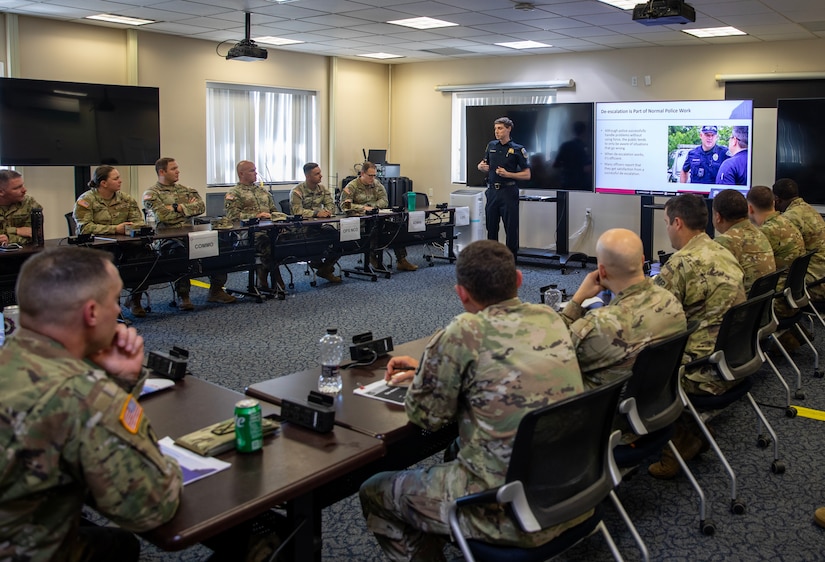
National Guardsmen Strengthen Skills Through De-Escalation Training


Soldiers from across the country participated in a de-escalation course hosted by the D.C. Metropolitan Police Department, Sept. 8, at the District of Columbia National Guard Armory in Washington.

A uniformed police officer stands at the front of a classroom with a TV screen on. About a dozen people wearing military camouflage uniforms are seated at tables lining the outside of the room.

The group of soldiers — primarily military police officers — represent several states currently supporting the D.C. Safe and Beautiful Task Force, Joint Task Force District of Columbia mission. They have been primarily tasked with providing assistance to local law enforcement as part of patrols across the district. 
 
The training is focused on equipping both civilian and military law enforcement officers with tools to achieve peaceful outcomes during high-intensity encounters. The instruction emphasizes communication skills and conflict resolution strategies designed to reduce the need for force and strengthen community trust. 
 
"Almost every encounter we have as law enforcement starts and ends with words," said D.C. Metropolitan Police Department Sgt. Marc Sansone, who led the training. "That sets the tone and closes the book for the interaction."
 
Included in the training were ways to de-escalate a conflict, how to observe traits during interactions, how to build rapport and how to use active listening when interacting with the public — particularly those in need. 
 
Army Capt. Aram Webb, assigned to the District of Columbia National Guard's Multi-Agency Augmentation Command, helped make the training a reality. The idea came to him from enlisted leaders on the ground in the district, who felt the training would make their teams better prepared to deal with what they may encounter on a day-to-day basis. 
 
"They were looking for additional ways and techniques to manage situations," Webb explained. "Overall, the soldiers have done a great job keeping everyone calm and working to lower tensions, but these techniques we are talking about are for soldiers to use to de-escalate not [just] the situation and other people, but themselves as well." 
 
Local and federal law enforcement partners in Washington have worked closely with National Guardsmen since the mission began in mid-August. Training opportunities for soldiers provided by those partners only further underscores the strong interagency cooperation both parties have developed in their pursuit to make Washington safe for those who work, live and visit the area. 
 
"The fact we are getting this great support from the [D.C.] Metropolitan Police Department is huge, and we are extremely appreciative of that," Webb said. "It highlights the integrated mission we have and the partnership we have developed."

Tuesday, September 09, 2025

Who’s at Fault When There’s No Driver? Law Enforcement and the Rise of Autonomous Vehicles

What happens when a police officer needs to stop a car for a traffic violation—only to discover there’s no driver? And if a crash occurs, but the automated driving system (ADS) was in control, who is responsible?

These aren’t hypothetical questions anymore. According to the Autonomous Vehicle Industry Association (AVIA), driverless ride-hail cars and delivery trucks have already logged more than 44 million miles on U.S. public roads as of early 2025. For law enforcement, emergency medical services (EMS), and fire/rescue personnel, that reality poses both opportunities and serious challenges.


A Federal Partnership for First Responder Safety

To get ahead of these issues, the U.S. Department of Justice Office of Community Oriented Policing Services (COPS Office) partnered with the International Association of Chiefs of Police (IACP) and the Virginia Tech Transportation Institute (VTTI). Together, they released Safety Considerations for Automated Driving Systems (ADS) Deployment, a white paper that provides guidance for safe, effective interactions between first responders and autonomous vehicles.

Backed by surveys of 378 law enforcement and first responder personnel, plus focus groups and subject-matter expert interviews, the report outlines best practices for handling situations involving partially or fully autonomous vehicles.


Three Types of Interactions with Driverless Cars

The white paper highlights three main categories of interactions:

  • Direct interactions – such as physically accessing the interior of a vehicle to reach a victim.

  • Indirect interactions – hand signals, sirens, or emergency lights to direct traffic.

  • Informational interactions – exchanging documents like registration or ownership information.

For each, the report provides scenarios and key takeaways, while stressing that responders must be able to:

  1. Identify an ADS-dedicated vehicle quickly.

  2. Signal it to stop and keep it stationary.

  3. Access ownership/registration information—even without a driver.


Concerns from the Field

First responders voiced concerns about whether autonomous vehicles can:

  • Recognize an officer standing in the roadway.

  • Respond correctly to traffic direction.

  • Safely handle crash scenes, given risks like high-voltage batteries and complex wiring.

Some officers suggested that future traffic direction may require standardized motions and equipment recognizable to ADS technology. Others raised the critical issue of liability—whether a crash stems from human error or vehicle error.


Training and Governance Recommendations

The white paper recommends expanding training for law enforcement and first responders so they can recognize and safely handle autonomous vehicles in emergencies. It also calls for collaboration between industry and law enforcement to:

  • Develop safety standards and operational guidelines.

  • Clarify liability and crash reporting protocols.

  • Ensure governance keeps pace with rapid technological deployment.

With driverless vehicles expected to reduce human-error crashes, provide mobility options for seniors and disabled populations, and support DUI reduction, the stakes for getting this right are high.


Read the Full White Paper

The complete white paper, Safety Considerations for Automated Driving Systems (ADS) Deployment, includes detailed scenarios, a resource list of more than 90 related research documents, and actionable recommendations for agencies nationwide.

👉 Read the full document here


Thursday, September 04, 2025

Working With His Wife to Dismantle Drug-Peddling Prison Gang

What motivated you to join the DEA?

I started out in law enforcement at the local level which was a step towards my desire to serve my community and make a difference. It was while I was working as a Narcotics Detective for the Scottsdale Police Department that I received an assignment to work in the Phoenix DEA office as a Task Force Officer (TFO) that an entire world of opportunity opened up to me. Making drug cases at the local level and getting to arrest those peddling poison to people in the community was rewarding, but getting the opportunity through DEA to take investigations all the way up to the major distributors, both in the United States and abroad was a game changer. I knew at that moment that through a career at DEA, I could go beyond helping the local community and have the ability to work investigations that could have an impact across the United States.

What does an average day as a Special Agent look like for you?

Several years back, I chose to move into a supervisory position in DEA in order to mentor and lead the next generation of DEA agents. As part of our career progression and preparation for higher leadership, we are required to complete a tour at DEA Headquarters. I am currently assigned as an Executive Assistant (EA) to the DEA Chief of Operations. The Chief of Operations oversees DEA enforcement actions and investigations throughout the United States and all across the world. My average day as an EA involves providing the Chief of Operations situational awareness on important issues that might rise to the level of the DEA Administrator and to help answer taskings that come down from the Administrator or outside DEA, such as from the Department of Justice, Congress, and the White House.  I also assist the Chief of Operations with making sure that DEA Headquarters is responsive to the needs of the agents in the field doing the hard, day-to-day work.

What has been your proudest moment as a Special Agent thus far?

My wife is a Special Agent with the FBI and my proudest moment as a Special Agent was getting the opportunity to work with my wife and the FBI in a joint DEA/FBI investigation that dismantled a violent white supremacist prison gang that was involved in distributing methamphetamine and firearms. The investigation was one of many in my career that showed that close cooperation and support with our fellow law enforcement partners at the local, state, and federal level can lead to dramatic results.

How can young people who wish to become a Special Agent best prepare themselves for the job?

As a Special Agent, we take an oath to defend the Constitution and uphold the nation’s laws. This means that for those interested in becoming a Special Agent, even before you take the oath of office, your life and your integrity have to be at the highest standards. Also, the job of a DEA Special Agent is one where you will be tested on a daily basis to go above and beyond – so seek out challenges for yourself, whether that be through academics, sports, or giving back to your community. The more you push and challenge yourself, the better equipped you will be to take on the responsibility of a DEA Special Agent.

The synthetic opioid fentanyl – often mixed into other drugs – is now responsible for tens of thousands of American deaths per year. How has the fentanyl epidemic changed your job?

The fentanyl epidemic has drastically changed the job of a DEA agent by increasing the urgency of our investigations. When we investigate drug organizations, we are always concerned about mitigating risks to the public, such as when we develop information that a drug target is going to commit a violent crime. In these situations, we act immediately and in coordination with our law enforcement partners to attempt to prevent violent crime. With the lethality of fentanyl, we now must be aware of potential risks to the public for the time it takes to conduct a thorough investigation. The goal of DEA investigations is to collect the evidence which leads to convictions and ultimately incarceration for those peddling poison, but sometimes we must weigh the risks posed by even a small amount of fentanyl reaching the streets of our communities and take action.