For more details on the investigation
into the stolen artifacts, read the press release issued by our Chicago Field
Office. And visit our art theft program page for information on other art
crimes, the National Stolen Art File database, and our dedicated Art Crime
Team, which—since its establishment in 2004—has been responsible for the
recovery of more than 2,650 items valued at over $150 million.
Showing posts with label world war ii. Show all posts
Showing posts with label world war ii. Show all posts
Friday, June 22, 2012
Stolen Artifacts Returned in Chicago


Wednesday, June 20, 2012
FBI Announces Return of Historic Artifacts to Polish Museum of America
The Chicago office of the Federal Bureau
of Investigation (FBI) announced today the return of approximately 120 stolen
historic artifacts to the Polish Museum of America (PMA). The artifacts, which
were believed to have been removed from the PMA sometime in the 1970s or 1980s,
were recovered by the FBI in 2011 from a Chicago residence.
The artifacts consisted of many items of
correspondence dating back as far as 1646, to include letters sent to and from
Polish kings, American presidents, a French emperor, and prominent
Revolutionary War figures. The collection also includes rare prints and
sketches, Polish military medals and memorabilia, as well as World War II
artifacts. The collective value of the artifacts being returned today has been
estimated at approximately $5 million.
The investigation that led to the
discovery of the artifacts was initiated by the PMA, who had been notified by a
Chicago coin and antiques dealer that documents traced to the PMA had been sold
to the dealer. According to the dealer, the sellers of the documents reported
that they had found them in the basement of a house in which they were tenants.
The dealer conducted his own research, and after learning that the documents
belonged to the PMA, notified the PMA that the documents had come into his
possession. Upon learning of the documents being sold to the dealer, the PMA in
turn contacted the FBI, and an investigation was initiated.
During the course of the investigation,
the FBI recovered additional documents and artifacts from the residence and
determined that the residence in which the artifacts were discovered was owned
by the mother of a former curator at the PMA. However, additional investigation
could not establish the date at which the artifacts disappeared from the PMA, nor
the person or persons responsible for removing them from the PMA. As a result,
no one was charged in connection with the disappearance of the artifacts, and
no criminal prosecutions will be forthcoming in the Northern District of
Illinois in connection with the theft, transportation, or possession of the
artifacts.
Established in 2004, the FBI’s Art Crime
Team is a rapid deployment team composed of 14 special agents assigned to
various FBI field offices across the country who have received specialized training
in art and cultural property crime investigations. The Art Crime Team has been
responsible for the recovery of more than 2,650 items valued at over $150
million. Additional information about the FBI’s art theft program, located at
FBI Headquarters in Washington, D.C., is available at www.fbi.gov.
Thursday, April 19, 2012
US government returns artwork taken during the Holocaust
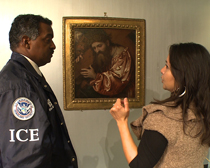 TALLAHASSEE, Fla. — A 400-year-old masterpiece work of art taken illegally from its owners in Nazi-occupied France during World War II was returned today to the family from which it was stolen more than 70 years ago.
Officials from U.S. Immigration and Customs Enforcement's (ICE) Homeland Security Investigations (HSI), the U.S. Attorney's Office for the Northern District of Florida, and Interpol Washington's U.S. National Central Bureau attended a ceremony in Tallahassee April 18 to return the rare painting by Girolamo de' Romani, known as Romanino, to the Gentili family.
HSI Tampa Special Agent in Charge Susan McCormick and U.S. Attorney Pamela Marsh, Northern District of Florida, officially signed over custody of the painting the same day to the Gentili heirs' legal representative, Maître Corinne Hershkovitch, who traveled from France to receive the artwork.
The painting, "Cristo Portacroce" (Christ Carrying the Cross), which dates to circa 1538, depicts Christ, crowned with thorns and wearing a striking copper-colored silk robe, carrying the cross on his right shoulder while being dragged with a rope by a soldier.
"Thanks to the tireless efforts of those involved, we are now righting a wrong perpetrated more than 70 years ago," said McCormick. "HSI will continue to investigate cases involving stolen art and cultural property from around the world and return the objects to their rightful owners."
Professor Lionel Salem, one of the heirs of the Gentili estate, could not be present for the ceremony but expressed his appreciation to the Department of Homeland Security for their "fantastic work" in investigating and pursuing the family's interest in the Romanino painting: "I am so deeply grateful for the efforts of DHS on this matter," he said. "The Gentili heirs are unanimous in wishing to convey the full extent of their immense gratitude."
"Today, during this momentous occasion, I commend the outstanding collaborative efforts of ICE/HSI, the U.S. Attorney's Office for the Northern District of Florida, and Interpol Washington for locating and returning this 400-year-old priceless piece of artwork to the Gentili family where it belongs. When law enforcement agencies partner and pull their respective resources, much can be accomplished at all levels," stated Interpol Washington Director Timothy A. Williams.
The painting was imported into the United States in March 2011 for temporary exhibit at the Mary Brogan Museum of Art and Science in Tallahassee. Following a lead from Interpol that called the painting's ownership into question, HSI special agents consulted the U.S. Attorney's Office and seized the painting at the museum Nov. 4, 2011, to protect the art until ownership could be confirmed through formal legal proceedings. B-roll of the seizure can be downloaded here.
The painting had been on display at the museum since March 18, 2011, as part of an exhibition of 50 baroque paintings on loan from the Pinacoteca di Brera in Milan, Italy.
The painting is among many works of art and other valuable items, taken in a forced sale from the estate of Federico Gentili di Giuseppe. Gentili died of natural causes in Paris in April 1940, just months before the Nazi army invaded France in 1941. After receiving advanced warning of the impending Nazi invasion, Federico Gentili's children and grandchildren fled from France, escaping to Canada and the United States. Other family members, who were unable to flee, died in concentration camps.
Gentili's grandchildren have taken legal steps internationally to find and reclaim works illegally taken from their family during the Nazi occupation. In a landmark 1999 decision relating to World War II plunder, a Paris Court of Appeals forced the Musee de Louvre in Paris to return five paintings to the Gentili family, and ruled that the auction of the Gentili estate in Nazi-occupied France was an illegal forced sale and a "nullity."
Earliest records about the painting indicate that it dates back to around 1538. It then appears in the collection of Antonio and Cesare Averoldi, and then in the Crespi Galerie. On June 4, 1914, after legally exporting a portion of the Crespi Collection from Italy, the Crespi Galerie put this painting and others up for auction in Paris, where it was subsequently purchased by Federico Gentili. After Gentili died, his estate was auctioned by French Vichy authorities in 1941, acting in concert with the Nazi occupiers; and the Gentili heirs were prohibited by law from returning to claim the painting. Several extraordinary anti-Semitic laws had been imposed, depriving French nationals who had left France of their nationality and arranging for confiscation of their property. Another German order, dated Sept. 27, 1940, established that, "Jews who had fled from the occupied zone were banned from returning there." As a result, the painting was sold in the illegal, forced sale of 1941. The painting was thereafter acquired by the Pinacoteca di Brera in 1998.
U.S. Attorney Marsh and Assistant U.S. Attorney Bobby Stinson prosecuted the federal case for the United States.
 U.S. Attorney Marsh praised the investigation by Interpol and HSI agents that brought this long-standing injustice to light: "Interpol and HSI deserve special credit for their efforts on this case. Their investigation not only identified the presence of this looted artwork in our district but also confirmed many details that were essential to a successful legal outcome. They obtained evidence from several different countries and also obtained documentation that confirmed the legal exportation of this painting from Italy prior to its sale to the Gentili family in France. It is not every day that our agents are required to track down and verify the provenance of a Renaissance painting. It was an unusual and dated investigative trail, but they were up to the challenge."
HSI plays a leading role in criminal investigations that involve the unauthorized importation and distribution of cultural property, as well as the illegal trafficking of artwork. The agency specializes in recovering works that have been reported lost or stolen. The HSI Office of International Affairs, through its 70 attaché offices in 47 countries, works closely with foreign governments to conduct joint investigations, when possible.
HSI specially trained investigators, assigned to both domestic and international offices, partner with governments, agencies and experts to protect cultural antiquities. They also train investigators from other nations and agencies on investigating crimes involving stolen property and art, and how to best enforce the law to recover these items when they emerge in the marketplace.
Since 2007, HSI has repatriated more than 2,500 items to more than 23 countries.
Wednesday, December 07, 2011
Remembering Pearl Harbor and the FBI’s Response
 Seventy years ago today—on December 7, 1941—a sneak attack on Pearl Harbor took the lives of more than 2,400 Americans, stunning the nation and catapulting it into war.
For the FBI, the attack and the onset of war opened a new chapter in national security. Even as Japanese bombs rained down, FBI Special Agent in Charge Robert Shivers in Honolulu was patched through via telephone to Director J. Edgar Hoover, who immediately put the Bureau on a 24/7 wartime footing according to its already well-made plans. In the days and months that followed, the FBI diligently and successfully worked to protect the American homeland from spies and saboteurs, building important new capabilities along the way.
Learn more about the FBI’s response to Pearl Harbor and its service during World War II.
Legal Attaché Paris
Pearl Harbor Attack Mobilizes FBI War Plans
Friday, November 04, 2011
ICE seizes rare painting stolen by the Nazis during World War II
See how World War II shaped modern police!
 TALLAHASSEE, Fla. – A masterpiece work of art – "Christ Carrying the Cross" – stolen as part of the widespread Nazi plunder of World War II, was seized today by U.S. Immigration and Customs Enforcement's (ICE) Homeland Security Investigations (HSI).
Since 2007, ICE HSI has repatriated more than 2,500 items stolen during World War II to more than 22 countries including paintings from France, Germany and Austria; an 18th century manuscript from Italy; and a bookmark belonging to Hitler, as well as cultural artifacts from Iraq including Babylonian, Sumerian and neo-Assyrian items.
TALLAHASSEE, Fla. – A masterpiece work of art – "Christ Carrying the Cross" – stolen as part of the widespread Nazi plunder of World War II, was seized today by U.S. Immigration and Customs Enforcement's (ICE) Homeland Security Investigations (HSI).The painting was seized through formal legal proceedings, to protect the art until its real ownership is finally confirmed. The U.S. Attorney's Office for the Northern District of Florida and ICE HSI filed a seizure action today against the painting "Christ Carrying the Cross Dragged by a Rascal," by Girolamo de' Romani, known as "Romanino." The painting, which dates to circa 1538, depicts Christ, crowned with thorns and wearing a striking copper-colored silk robe, carrying the cross on his right shoulder while being dragged with a rope by a soldier. It has been on display at the Mary Brogan Museum of Art and Science since March 18, 2011, and was part of an exhibition of 50 Baroque paintings on loan from the Pinacoteca di Brera in Milan, Italy.
The seizure complaint and supporting affidavit allege that the painting is among many works of art and other valuable items taken in a forced sale from the estate of Federico Gentili di Giuseppe. Gentili died in 1940 in Paris of natural causes, just months before the Nazi army invaded France in 1941. After receiving advanced warning of the impending Nazi invasion, Federico Gentili's children and grandchildren fled from France, escaping to Canada and the United States. Other family members, who were unable to flee, died in concentration camps.
Gentili's grandchildren have taken legal steps internationally to find and reclaim works illegally taken from their family during the Nazi occupation. In a landmark 1999 decision relating to World War II plunder, a French Court of Appeals forced the Musee de Louvre in Paris to return five paintings to the Gentili family, and ruled that the auction of the Gentili estate in Nazi-occupied France was an illegal forced sale and a "nullity."
"It's never too late to right a wrong. Many people know about the massive theft and illegal sale of precious art belonging to Jewish families during World War II. They should also know that today there is an international network of law enforcement agencies working diligently to correct these injustices," said ICE Director John Morton. "ICE's Cultural Property, Art and Antiquities unit was established for this very reason – to identify, investigate and return cultural treasures to their rightful owners."
U.S. Attorney Pamela C. Marsh, Northern District of Florida, said that under U.S. law, the painting cannot be returned to Italy until the ownership disputes are resolved. "Our interest is strictly to follow the law and safeguard this work until the courts determine rightful ownership. Through this process, all rightful claimants may be heard, and we can rest assured that justice will be done for all parties involved in the dispute."
Earliest records about the painting indicate that it dates back to around 1538. It then appears in the collection of Antonio and Cesare Averoldi, and then in the Crespi Galerie. On June 4, 1914, the Crespi Galerie put this painting and others up for auction in Paris, where it was subsequently purchased by Federico Gentili. After Gentili died, his estate was auctioned by French Vichy authorities in 1941, acting in concert with the Nazi occupiers, and the Gentili heirs were prohibited by law from returning to claim the painting. Several extraordinary anti-Semitic laws had been imposed, depriving French nationals who had left France of their nationality and arranging for confiscation of their property. Another German Order dated Sept. 27, 1940, established that, "Jews who had fled from the occupied zone were banned from returning there." As a result, the painting was sold in the illegal, forced sale of 1941. The painting was thereafter acquired by the Pinacoteca di Brera in 1998.
U.S. Attorney Marsh and Assistant U.S. Attorney Bobby Stinson are prosecuting the federal case for the United States.
ICE HSI plays a leading role in criminal investigations that involve the illicit importation and distribution of cultural property, as well as the illegal trafficking of artwork. The agency specializes in recovering works that have been reported lost or stolen. The ICE HSI Office of International Affairs, through its 70 attaché offices in 47 countries, works closely with foreign governments to conduct joint investigations, when possible.
ICE HSI specially trained investigators, assigned to both domestic and international offices, partner with governments, agencies and experts to protect cultural antiquities. They also train investigators from other nations and agencies on investigating crimes involving stolen property and art, and how to best enforce the law to recover these items when they emerge in the marketplace.
Wednesday, February 23, 2011
Transfer ceremony marks return of antique porcelain to heirs of former German prime minister

Investigation results in repatriation of the "Nereid Sweetmeat Stand" to Dresden State Art Collections
TOLEDO, Ohio - A valuable piece of porcelain will be returned to a German art collection following the successful conclusion of a an investigation conducted by U.S. Immigration and Customs Enforcement's (ICE) Homeland Security Investigations (HSI). The return was marked Feb. 23, 2011 in a ceremony at the Toledo Museum of Art. The centerpiece, manufactured in Meissen, Germany, from the famed Swan Service will be returned to the Dresden State Art Collection.
Before World War II, several pieces of this dinner service were on loan to what was then called the Museum of Applied Art in Dresden from the family of Count Heinrich von Bruehl, a former prime minister of Saxony.
During World War II, the Nereid Sweetmeat Stand was stolen. After a forensic investigation by ICE, the Nereid Sweetmeat Stand, which has been in the Toledo Museum of Art's collection since 1956, was determined to be the same piece taken from Dresden. Custody will transfer to the Dresden State Art Collections on behalf of the von Bruehl heirs, who have agreed to lend the work to the Dresden museum upon its return to Germany.
"Today's ceremony rights a decades-old wrong and reconnects this valuable artifact to its rightful cultural origin and history," said ICE Director John Morton. "This artifact represents an important part of the German national heritage and identity and we are grateful to be involved in its return."
"While we are certainly sad to see the Nereid leave us, we take pride in the fact that the Toledo Museum of Art upholds the highest standards of museum practice by fully cooperating with the investigation and then returning a beloved piece that has been definitively proven not to be ours," said Carol Bintz, chief operating officer of the Toledo Museum.
In 1737, Count Heinrich von Bruehl, the founding patron of the Meissen porcelain factory, ordered the factory's chief modeler to create a dinner service. The result, four years in the making, was the Swan Service - a dinner service for 100 comprising 2,200 pieces. The Nereid Sweetmeat Stand, part of the centerpiece arrangement, is considered one of the masterpieces of the collection.
The Swan Service remains one of the most celebrated achievements in European porcelain because of its unprecedented size and beauty. Only about 200 pieces survive, scattered in collections around the world. Of the four Nereids, the whereabouts of only two are currently known. One is a heavily damaged piece on display in a museum in Berlin. The Nereid that has been in the Toledo Museum of Art's collection, and prior to that in Dresden, is the only known complete Nereid, making it one of the most valuable pieces remaining of the Swan Service.
In August 1920, the Dresden Museum of Applied Art received 25 pieces of the Swan Service, including the stand, on permanent loan from the von Bruehl family. These pieces, along with others in the collection, were hidden at the Reichstaedt castle in Germany toward the end World War II. After the war, the boxes were found opened, with the Nereid stand and several other pieces missing.
In 1955, the stand was purchased by a New York firm from a European art dealer, and subsequently imported into the United States. The Toledo Museum of Art acquired the Nereid in good faith from a reputable New York dealer in 1956, and has had the Nereid on public display since that time.
In November 2010, the stand was determined to be the stolen Nereid Sweetmeat Stand after a forensic examination conducted by staff from the Toledo Museum of Art, the Dresden State Art Collection, the Cleveland Museum of Art, and special agents from ICE HSI. This determination followed months of diligent investigation by agents from HSI offices in Cleveland, New York and Frankfurt, as well as the cooperation of the Toledo Museum of Art and the Dresden State Art Collection.
The piece is scheduled to go on display in Dresden later this year.
Wednesday, January 02, 2008
Police History, Korea and Community Relations
January 2, 2008 (San Dimas, CA) Police-Writers.com is a website that lists state and local police officers who have written books. Police officers who have written on history and community policing were added to the website.
Todd L. Shulman is a seven-year member of the Napa Police Department, (California) currently serving as a detective. An avid historian, Todd Shulman founded the Napa Police Historical Society in 2006 and has culled their archives for many of the photographs included in his book, Napa County Police. According the book description of Napa County Police, “with dazzling vintage imagery and rich historical text, Todd Shulman tells the tale of policing Napa County - from the Wild West days of the 1850s, through the boom era of the 1940s, and into the 21st century.”
Alfred F. McDonald, a retired Buffalo Police Department (New York) Lieutenant, was born and raised in Buffalo, New York. He served his country in the United States Navy during World War II from 1944 – 1947, was placed on inactive reserves and was called back to duty during the Korean Conflict in 1950. He served in the Navy again from late in 1950 through 1952. After being honorably discharged from the Navy, Alfred McDonald returned to civilian life as a husband and father. Having been brought up with strong family values and work ethic, Al worked hard at the railroad as a brakeman, until becoming a police officer in 1956. From there, Al’s career flourished and he advanced until reaching his retirement rank of Lieutenant. Alfred McDonald is the author of Korea ‘Operation War Dance.’
According to the book description, Korea – Operation War Dance is “one man’s personal account of shipboard life of the men on the U.S.S. Silverstein. It’s about being under attack, living conditions on the ship, every aspect of a sailor’s life during the time period; and, is a tribute to the brave men and women who served their country during the Korean Conflict.”
Rick Braziel has been a member of the Sacramento Police Department for 28 years, and a Deputy Chief since 2002. In December 2007, he was appointed as chief of police of the Sacramento Police Department. He is a second generation police officer with his father Dick serving the Department for over 20 years. Rick Braziel consults and instructs for Humboldt State University in Teambuilding, Communication Skills, and Leadership. He received his Bachelor of Arts and Master of Arts degrees in Communication from California State University, Sacramento.
In 2006, Rick Braziel received a Master of Arts in Security Studies (Homeland Security and Defense) from the U.S. Naval Postgraduate School. Rick is also a 2002 graduate and class spokesperson of the California Peace Officer Standards and Training (P.O.S.T.) Command College; and 2004 graduate of the Police Executive Research Forum’s (P.E.R.F.) Senior Management Institute for Police.
Rick Braziel is co-author of the book titled COP Talk: Essential Communication Skills for Community Policing.
According to Kevin Brown, of Montana State University-Northern, in the American Communication Journal, “In this text for police officers the authors lay out the basics of the communication process with helpful vignettes derived from actual police experience to illustrate the principles. The authors lead the reader through a tour of contemporary communication contexts. The authors start with interpersonal communication and cover work groups, public speaking, community meetings, problem solving, network building and finally, public relations. The book is written for a beginning communication student and reflects an understanding that many police officers have had no formal communication training.”
Police-Writers.com now hosts 820 police officers (representing 367 police departments) and their 1731 law enforcement books in six categories, there are also listings of United States federal law enforcement employees turned authors, international police officers who have written books and civilian police personnel who have written books.
Todd L. Shulman is a seven-year member of the Napa Police Department, (California) currently serving as a detective. An avid historian, Todd Shulman founded the Napa Police Historical Society in 2006 and has culled their archives for many of the photographs included in his book, Napa County Police. According the book description of Napa County Police, “with dazzling vintage imagery and rich historical text, Todd Shulman tells the tale of policing Napa County - from the Wild West days of the 1850s, through the boom era of the 1940s, and into the 21st century.”
Alfred F. McDonald, a retired Buffalo Police Department (New York) Lieutenant, was born and raised in Buffalo, New York. He served his country in the United States Navy during World War II from 1944 – 1947, was placed on inactive reserves and was called back to duty during the Korean Conflict in 1950. He served in the Navy again from late in 1950 through 1952. After being honorably discharged from the Navy, Alfred McDonald returned to civilian life as a husband and father. Having been brought up with strong family values and work ethic, Al worked hard at the railroad as a brakeman, until becoming a police officer in 1956. From there, Al’s career flourished and he advanced until reaching his retirement rank of Lieutenant. Alfred McDonald is the author of Korea ‘Operation War Dance.’
According to the book description, Korea – Operation War Dance is “one man’s personal account of shipboard life of the men on the U.S.S. Silverstein. It’s about being under attack, living conditions on the ship, every aspect of a sailor’s life during the time period; and, is a tribute to the brave men and women who served their country during the Korean Conflict.”
Rick Braziel has been a member of the Sacramento Police Department for 28 years, and a Deputy Chief since 2002. In December 2007, he was appointed as chief of police of the Sacramento Police Department. He is a second generation police officer with his father Dick serving the Department for over 20 years. Rick Braziel consults and instructs for Humboldt State University in Teambuilding, Communication Skills, and Leadership. He received his Bachelor of Arts and Master of Arts degrees in Communication from California State University, Sacramento.
In 2006, Rick Braziel received a Master of Arts in Security Studies (Homeland Security and Defense) from the U.S. Naval Postgraduate School. Rick is also a 2002 graduate and class spokesperson of the California Peace Officer Standards and Training (P.O.S.T.) Command College; and 2004 graduate of the Police Executive Research Forum’s (P.E.R.F.) Senior Management Institute for Police.
Rick Braziel is co-author of the book titled COP Talk: Essential Communication Skills for Community Policing.
According to Kevin Brown, of Montana State University-Northern, in the American Communication Journal, “In this text for police officers the authors lay out the basics of the communication process with helpful vignettes derived from actual police experience to illustrate the principles. The authors lead the reader through a tour of contemporary communication contexts. The authors start with interpersonal communication and cover work groups, public speaking, community meetings, problem solving, network building and finally, public relations. The book is written for a beginning communication student and reflects an understanding that many police officers have had no formal communication training.”
Police-Writers.com now hosts 820 police officers (representing 367 police departments) and their 1731 law enforcement books in six categories, there are also listings of United States federal law enforcement employees turned authors, international police officers who have written books and civilian police personnel who have written books.
Subscribe to:
Posts (Atom)


 Posts
Posts

