Murder
on the Zuni Reservation
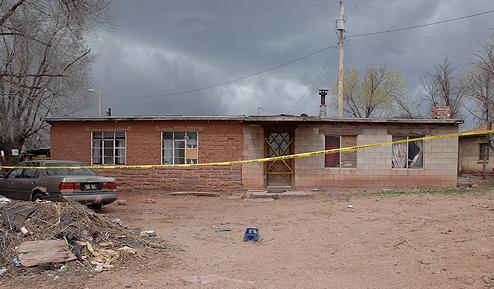 Special Agent John Fortunato walked
behind the abandoned house on the Zuni Reservation in western New Mexico and
pointed out where Floyd Yuselew dug a grave to bury the friend he had murdered
with an ax to the head.
Special Agent John Fortunato walked
behind the abandoned house on the Zuni Reservation in western New Mexico and
pointed out where Floyd Yuselew dug a grave to bury the friend he had murdered
with an ax to the head.
The two had been drinking, and
investigators believe the murder was committed because Yuselew thought his
buddy had been flirting with his girlfriend. When tribal police and the FBI
learned of the crime in March 2009, they found the victim still sitting in the
chair where he had been killed months earlier. Because the house was unheated
throughout the cold winter, the body—and the crime scene—had been perfectly
preserved.
Uncertain what to do with the body, and
not wishing to live in his house with a corpse, Yuselew and his girlfriend
moved in with friends. Periodically, he returned to dig in the frozen backyard
to make a grave. Later, Yuselew was afraid his girlfriend would turn him in for
the murder when their relationship ended badly, so he called the Zuni police,
told them about the body, and tried to pin the crime on her.
As unusual as the case may seem, in many
ways it is a common Indian Country crime: a tragic killing successfully
investigated and prosecuted thanks to the strong relationships between tribal
authorities, the FBI, and federal prosecutors. Criminal jurisdiction in Indian
Country is a complicated web of tribal, state, and federal rules. The sovereign
status of many tribes precludes most states from exercising jurisdiction.
Instead, that authority resides with the tribes, but only for non-felony
offenses. It is the FBI’s responsibility to investigate major crimes such as
murder, and tribal authorities rely on the muscle of the federal judicial
system to prosecute those crimes to the fullest.
“By law these major crimes are federally
prosecuted, and the FBI is the vehicle for getting them to federal court,” said
Special Agent Mike Harrigan, who supervises a squad of Indian Country
investigators. “But the successful investigation of such crimes isn’t just a
Bureau role,” he added, “it is a tribal and Bureau partnership.”
“We have a close relationship with all
the tribal police,” Fortunato said. “It would be difficult for us to do our
jobs without that partnership, and they depend on us as well.” In the Yuselew
case, for example, Fortunato called in the Bureau’s Evidence Response Team
(ERT) to help work the crime scene.
“When
ERT processed the scene,” he explained, “there was a lot of blood and other
evidence, like alcohol cans we were able to pull fingerprints from. The blood
spatter and other evidence inside the house made it clear it was not the
girlfriend who did the crime.”
In the end, Yuselew pled guilty to
second-degree murder and is currently serving a 17-year sentence. The case is
one of many senseless crimes Fortunato and his colleagues investigate in Indian
Country. “We invariably see the bad side of things here,” he said. “We are
constantly seeing tragedy, loss, and people who hurt family members. That is
the hardest thing for me about working in Indian Country.”
Still, Fortunato is pleased that justice
was served in the Yuselew case, and he believes in the goodness of the vast
majority of Native Americans. “Anyone who has visited the Navajo and Zuni
reservations and spent time here will tell you that most of the people are
terrific, very friendly, and welcoming.”
Indian
Country Jurisdiction
Criminal jurisdiction on tribal lands
also varies depending on the reservation and the state in which it is located,
Harrigan added. “Sometimes it’s Bureau of Indian Affairs investigators who have
jurisdiction on behalf of the tribes. Here in New Mexico,” he said, “generally
the tribes have their own police departments. They get funding from the federal
government for law enforcement. The FBI works with their criminal investigators
who are trained to federal standards.”
Next:
A team effort makes a difficult job easier.


 Posts
Posts


No comments:
Post a Comment