Showing posts with label international association of chiefs of police. Show all posts

Monday, October 31, 2011

ICE announces results of 'Operation Strike Out'

Massive sports memorabilia bootlegging: just another day on the job for American police officers! Get the latest and best police news as it happens!

WASHINGTON - With the conclusion of Major League Baseball's 2011 World Series, U.S. Immigration and Customs Enforcement's (ICE) Homeland Security Investigations (HSI) and the National Intellectual Property Rights Coordination Center (IPR Center) have announced the results of "Operation Strike Out." This one-month operation, which commenced at the beginning of the American League and National League Championship Series, has resulted in the seizure of 58 commercial websites that sold and distributed counterfeit sports paraphernalia. HSI special agents have also seized 5,347 items with a manufacturer's suggested retail price (MSRP) of $134,862.

"HSI and the IPR Center have made a major dent in these criminals' plans to profit from fan enthusiasm surrounding a very exciting seven-game World Series - both in U.S. cities and in cyberspace," said ICE Director John Morton. "Counterfeits products represent a triple threat by delivering shoddy and sometimes dangerous goods into commerce, by funding organized criminal activities, and by denying Americans good-paying jobs. Homeland Security Investigations and our partners at the IPR Center will continue to work together to keep all types of counterfeit products off our streets."

Website seizures
The seizure of the 58 domain names is the seventh phase of "Operation In Our Sites," a sustained law enforcement initiative to protect consumers by targeting counterfeiting and piracy over the Internet. In June 2010, the IPR Center began "Operation In Our Sites." Since the launch of this operation in June 2010, the IPR Center has seized a total of 200 domain names and redirected those domain names to a seizure banner.

Previous website seizures include:

•First phase: 10 domain names
•Second phase: 82 domain names
•Third phase: 10 domain names
•Fourth phase: 18 domain names
•Fifth phase: 5 domain names
•Sixth phase: 17 domain names

The 58 domain names seized in this phase of "Operation In Our Sites," were all commercial websites engaged in illegally selling and distributing counterfeit sports paraphernalia. During the course of the operation, federal law enforcement agents made undercover purchases of sport jerseys from online retailers suspected of selling counterfeit goods.

Once the materials were confirmed to be counterfeit or otherwise illegal, ICE HSI special agents obtained seizure orders from federal magistrate judges for the domain names of the websites that sold or distributed the items. In most instances, the counterfeit goods were shipped directly into the United States from suppliers in other countries using international express mail. The 58 websites have all been shut down and now show a banner stating that the domain name of that website has been seized by federal authorities. The seizure banner on the seized sites has received nearly 75 million individual views.

The seized counterfeit items infringed on the copyrights or trademarks owned by: Major League Baseball, the National Basketball Association, the National Football League and the National Hockey League.

Eighty-six of the 200 domain names seized have now been forfeited to the United States government. Through the forfeiture process, individuals who have an interest in the seized domain names are provided a period of time after the "Notice of Seizure" to file a petition with a federal court and additional time after the "Notice of Forfeiture" to contest the forfeiture. If no petitions or claims are filed, the domain names become property of the U.S. government.

In April 2011, the IPR Center launched a public service announcement (PSA) that appears on each of the 86 forfeited domain names. This video has received nearly 200,000 individual views on ICE's YouTube page, educating the public about the economic impact of trademark counterfeiting and copyright infringement. The PSA helps deter future crimes and raises awareness.

The "Operation In Our Sites" portion of "Operation Strike Out" was spearheaded by the National Intellectual Property Rights Coordination Center (IPR Center); as well as HSI offices in Baltimore; Denver; Detroit; El Paso, Texas; Houston; Seattle; St. Paul, Minn.; and in coordination with the following U.S. Attorneys' Offices: Southern District of Texas, District of Colorado, Eastern District of Michigan, Western District of Washington, Western District of Texas, District of Minnesota and District of Maryland.

Last week, "Operation In Our Sites" received recognition by the International Association of Chiefs of Police (IACP). The IPR Center received an IACP Award for Excellence in Criminal Investigation for its work in targeting counterfeiting and piracy on the Internet. The award recognizes quality achievement and innovation in managing and conducting criminal investigations with the goal of sharing information to advance the art and science of criminal investigations.

'Hard goods' seizures
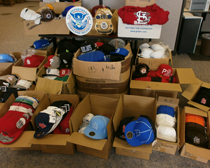
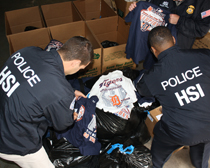
ICE HSI special agents operated in multiple teams to identify stores and vendors selling counterfeit trademarked items. These teams - operating in Dallas; Detroit; Milwaukee, Wis.; and St. Louis - have seized 5,347 items of phony World Series-related memorabilia along with other counterfeit Major League Baseball and sports related items to date totaling $134,862. Ball caps, t-shirts, jackets, tickets and other souvenirs are among the counterfeit merchandise and clothing confiscated. Three individuals were also arrested on federal and state counterfeiting violations.

The breakdown of seized items include:

•Dallas: 270 items with an MSRP of $6,934
•Detroit: 913 items with an MSRP of $16,120
•Milwaukee: 106 items with an MSRP of $3,180
•St. Louis: 4,058 items with an MSRP of $108,628

IPR Center
The IPR Center is one of the U.S. government's key weapons in the fight against criminal counterfeiting and piracy. The IPR Center uses the expertise of its 19 member agencies to share information, develop initiatives, coordinate enforcement actions, and conduct investigations related to IP theft. Through this strategic interagency partnership, the IPR Center protects the public's health and safety, the U.S. economy and the war fighters.

Tuesday, October 25, 2011

Supporting the Law Enforcement Officers and First Responders Who Keep Our Nation Safe

The following post appears courtesy of Attorney General Eric Holder and Secretary Janet Napalitano.

Keeping our nation safe from evolving terrorist threats requires strong partnerships at all levels.  Nowhere are those partnerships more important than with our federal, state, local, and tribal law enforcement officers who work on the frontlines every day to keep our cities and communities safe.

These courageous men and women, who put their lives on the line to protect others, must have the tools, training, and resources they need to do their jobs safely and effectively.

This week at the International Association of Chiefs of Police (IACP) General Assembly in Chicago, we each had an opportunity to reiterate our support for police officers and first responders across our country, many of whom are struggling to hire or retain personnel in the face of tough economic challenges.

As part of ongoing work to better understand and overcome current fiscal challenges, this week, the Justice Department’s Community Oriented Policing Services (COPS) office released a new report on how the economic downturn has impacted police departments nationwide.

According to the department’s research, we expect that, by the end of this year, nearly 12,000 police officers and sheriff’s deputies will have been laid off.  Already, law enforcement agencies nationwide currently have nearly 30,000 unfilled vacancies.  And an estimated 28,000 more officers and deputies experienced week-long furloughs last year. In 25 years of collecting data, this is the first national decrease in law enforcement positions ever recorded.

There is great demand for existing federal fire fighter hiring funding.  In FY10 alone there were $1.8 billion in applications for $420 million in  SAFER funds.

Especially in these difficult economic times, the tough choices we are all facing should not come at the expense of public safety and national security.  And, fortunately, they don’t have to. The American Jobs Act would provide $5 billion in assistance to states and local communities to create and save thousands of police and first responder jobs across the country.  These funds would not only help to safeguard our national security and bolster public safety – they would strengthen our economy.

Passage of the American Jobs Act also would ensure that many of the critical partnerships we have established with local law enforcement can continue – and improve our ability to share information, to train frontline officers to recognize indicators of terrorism and crime, and to encouraging the public to be vigilant in reporting suspicious activity to appropriate authorities.

These steps provide a strong foundation for law enforcement at all levels to protect communities from terrorism and other threats. They also help us better understand the risks confronting the homeland while protecting the privacy rights and civil liberties of all Americans, and foster a strong relationship with the international community.

When it comes to advancing our public safety efforts, we simply can’t afford to wait. We must take action now to combat the economic conditions that have affected – and, in some communities, devastated – law enforcement agencies nationwide. We urge Congress to pass the American Jobs Act so that we can protect the men and women on the frontlines who protect us and contribute to our nation’s safety and security every day.

Thursday, August 19, 2010

DEA Heads First-Ever Nationwide Prescription Drug Take-Back Day

AUG 19 -- WASHINGTON, D.C. – The Drug Enforcement Administration and government, community, public health and law enforcement partners today announced a nationwide prescription drug “Take-Back” initiative that seeks to prevent increased pill abuse and theft. DEA will be collecting potentially dangerous expired, unused, and unwanted prescription drugs for destruction at sites nationwide o n Saturday, September 25 th from 10 a.m. to 2 p.m. local time. The service is free and anonymous, no questions asked.

This initiative addresses a vital public safety and public health issue. Many Americans are not aware that medicines that languish in home cabinets are highly susceptible to diversion, misuse, and abuse. Rates of prescription drug abuse in the U.S. are increasing at alarming rates, as are the number of accidental poisonings and overdoses due to these drugs. Studies show that a majority of abused prescription drugs are obtained from family and friends, including from the home medicine cabinet. In addition, many Americans do not know how to properly dispose of their unused medicine, often flushing them down the toilet or throwing them away – both potential safety and health hazards.

“Today we are launching a first-ever National Prescription Drug Take-Back campaign that will provide a safe way for Americans to dispose of their unwanted prescription drugs,” said Michele M. Leonhart, Acting Administrator of the Drug Enforcement Administration. “This effort symbolizes DEA’s commitment to halting the disturbing rise in addiction caused by their misuse and abuse. Working together with our state and local partners, the medical community, anti-drug coalitions, and a concerned public, we will eliminate a major source of abused prescription drugs, and reduce the hazard they pose to our families and communities in a safe, legal, and environmentally sound way.”

“With this National Prescription Drug Take-Back campaign, we are aggressively reaching out to individuals to encourage them to rid their households of unused prescription drugs that pose a safety hazard and can contribute to prescription drug abuse,” said Acting Deputy Attorney General Gary G. Grindler. “The Department of Justice is committed to doing everything we can to make our communities safer, and this initiative represents a new front in our efforts.”

“Prescription drug abuse is the Nation’s fastest-growing drug problem, and take-back events like this one are an indispensable tool for reducing the threat that the diversion and abuse of these drugs pose to public health,” said Director of National Drug Control Policy Gil Kerlikowske. “The Federal/state/and local collaboration represented in this initiative is key in our national efforts to reduce pharmaceutical drug diversion and abuse.”

Collection sites in every local community can be found by going to www.dea.gov . This site will be continuously updated with new take-back locations. Other participants in this initiative include the White House Office of National Drug Control Policy; the Partnership for a Drug-Free America; the International Association of Chiefs of Police; the National Association of Attorneys General; the National Association of Boards of Pharmacy; the Federation of State Medical Boards; and the National District Attorneys Association.

Friday, October 30, 2009

Part Badge, Part Tights: All Hero

On November 5, 2009, Conversations with American Heroes at the Watering Hole will feature a discussion with former Ellis County Sheriff’s Department deputy sheriff Dr. Brian A. Kinnaird.

Program Date: November 5, 2009
Program Time: 1700 hours, Pacific
Topic: Part Badge, Part Tights: All Hero
Listen Live:
www.americanheroesradio.com/part_badge_part_tights_all_hero.html

About the Guest
Brian A. Kinnaird “is an internationally recognized scholar, author, and trainer in the fields of criminal justice and social psychology. As a commissioned law enforcement officer, Dr. Kinnaird served as Deputy Sheriff in Ellis County, KS where he held assignments in field training, use of force instruction, and tactical team operations. Following almost a decade of police duty, Kinnaird went on to serve as a tenured professor, director, and department chair of Justice Studies at Fort Hays State University (KS). In 2007, Dr. Brian A. Kinnaird returned to his hometown of Salina, KS where he has released his third book. He continues to teach university courses and train law enforcement officers & agencies.

Dr. Kinnaird earned his Ph.D. in human services/
criminal justice from Capella University (Minneapolis, MN) preceded by a B.A. in sociology and M.L.S. in criminal justice from Fort Hays State University (Hays, KS). Kinnaird is published in a wide variety of outlets including peer-reviewed journals, books, book chapters, trade publications, reviews, and columns. He is a Policy Fellow with the Docking Institute of Public Affairs and has had policy work featured as best practices by the International Association of Chiefs of Police and the Florida Department of Law Enforcement.”

Brian A. Kinnaird is the author of Use of Force: Expert Guidance for Decisive Force Response; Exploring Police Liability Profiles: Proximate Cause Analysis of Police Misconduct in the San Francisco, CA Police Department; and, Part Badge. Part Tights. All Hero.

According to the book description of Part Badge. Part Tights. All Hero, “Metropolis and Gotham City have always had watchful guardians. Comic book civilizations are full of them—extraordinary people who choose to share their authentic gifts to help others. Superheroes, as pop culture symbols of justice, have long been known in our
law enforcement community to be a source of inspiration and moral guidance for a life served to protect. From Superman and The Lone Ranger to our men and women in blue, Brian Kinnaird examines the spirit of heroism and the human instinct to seek order and meaning in a dangerous world where today’s superheroes wear a badge and gun.”

About the Watering Hole
The Watering Hole is
Police slang for a location cops go off-duty to blow off steam and talk about work and life. American Heroes Radio brings you to the watering hole, where it is Sometimes funny; sometimes serious; but, always interesting.

About the Host
Lieutenant Raymond E. Foster was a sworn member of the Los Angeles Police Department for 24 years. He retired in 2003 at the rank of Lieutenant. He holds a bachelor’s from the Union Institute and University in
Criminal Justice Management and a Master’s Degree in Public Financial Management from California State University, Fullerton; and, has completed his doctoral course work. Raymond E. Foster has been a part-time lecturer at California State University, Fullerton and Fresno; and is currently a Criminal Justice Department chair, faculty advisor and lecturer with the Union Institute and University. He has experience teaching upper division courses in Law Enforcement, public policy, Police Technology and leadership. Raymond is an experienced author who has published numerous articles in a wide range of venues including magazines such as Government Technology, Mobile Government, Airborne Law Enforcement Magazine, and Police One. He has appeared on the History Channel and radio programs in the United States and Europe as subject matter expert in technological applications in Law Enforcement.

Listen, call, join us at the Watering Hole:
www.americanheroesradio.com/part_badge_part_tights_all_hero.html

Program Contact Information
Lieutenant Raymond E. Foster, LAPD (ret.), MPA
editor@police-writers.com
909.599.7530

Thursday, May 01, 2008

Public Safety Technology in the News May 1, 2008

IACP Issues Red Light Camera Systems Specifications
The Police Chief, (02/2008)

A performance standard has been created to help
law enforcement agencies choose a red light camera system. Because of the increase in the number of agencies using red light cameras, the Enforcement Technologies Advisory Technical Subcommittee of the International Association of Chiefs of Police (IACP) Highway Safety Committee created a performance standard. The protocols and specifications laid out in the standard are meant to bolster the confidence of agencies, citizens, and courts in the precision and consistency of the camera systems. To obtain the standard, Red Light Camera Systems Minimum Performance Specifications, visit the IACP website www.theiacp.org/profassist/redlight.htm. IACP also maintains a conforming product list that lists systems that have been tested and found to comply with the specifications. www.policechiefmagazine.org/magazine/index.cfm?fuseaction=display_arch&article_id=1423&issue_id=22008

License Plate Recognition Systems Extend the Reach of Patrol Officers
Government
Technology, (04/09/2008), Jim McKay

In an area like the United Kingdom, where the number of cameras used for public safety surveillance has grown to more than 4 million and estimates are that citizens get their images captured more than 300 times in a day, license plate recognitions
technology is a common tool for law enforcement. Initially, use in the United States was limited to toll plazas on the EZ Pass lanes to capture the license plates of motorists going through the lanes without the required RF transponder equipment. License plate recognition systems are now beginning to take hold in the United States for other purposes, and law enforcement agencies are seeing positive results. Of the 1,800 law enforcement agencies nationwide, 400 have at least one system, and because of the positive results and a drop in prices, more agencies will be able to purchase the technology. www.govtech.com/gt/articles/282014

Met
Police Officers to be 'Microchipped' by Top Brass in Big Brother Style Tracking Scheme
The Daily Mail, (04/10/2008)

Met
Police will replace the ailing Airwave radio system with a microchip system that will aid in the tracking and movement of the 31,000 officer force. The device, identified as Automated Personal Locations System (APLS) and provided by Telent, will allow dispatchers at the agency's operations center to identify officer locations, whether above or below ground, at any time during the officer's shift. Administrators indicate that the switch to this type of tracking is to improve officer safety and to help the agency be more efficient in responding to incidents. According to Telent, the system will be one of the largest globally, covering approximately 620 miles. www.dailymail.co.uk/pages/live/articles/news/news.html?in_article_id=558597&in_page_id=1770

Bethlehem Is Ready to Implement Video System in Crime Areas
The Morning Call, (04/08/2008), Pamela Leham

A video showing three teens robbing a drunken man at 3 a.m. led to the teens being caught and prosecuted for the crime. Results like these have prompted the Bethlehem (Pennsylvania)
police to acquire six pole-mounted camera systems for use throughout the city for special events and emergency situations. Mayor John Callahan believes these cameras are equal to a 24/7 police presence where the police officer has "a photographic memory" that can be admitted as evidence in court. Allentown, near Bethlehem, has 20 cameras and wants to increase the amount to 80, while Easton Housing Authority hopes to implement video surveillance for use with its Weed and Seed project. www.mcall.com/news/local/all-b1_4camera-r.6349385apr08,0,5186533.story

Ready for Your (Driving) Closeup?
Los Angeles Times, (04/14/2008), Steve Hymon

States like Arizona, Illinois, Maryland, Oregon, and Washington have implemented the use of radar-activated speed enforcement cameras to catch speeders on highways. Now the
Beverly Hills Police Department is again attempting to push for legislation that will allow the use of such cameras in California. Officials have been trying since 2006 with no luck, but the growing list of States using the technology may indicate that opposition is decreasing. For the Beverly Hills Police Department, the issue is that police patrol the busy areas and drivers take short cuts through residential areas at high rates of speed. Scottsdale (Arizona) has this problem and instituted the use of cameras, which resulted in a 9 mph decrease in speed. The legislation being pushed in California would implement a pilot mobile unit that could be used in school zones and residential areas where the posted limit is 25 mph. Also, with this pilot project motorists would be provided with ample signage ind! icating the camera system was in use. This past January, the Governors Highway Safety Association indicated that because budget cuts have reduced the number of officers available for speed enforcement, more cameras are needed to aid agencies. www.latimes.com/classified/automotive/highway1/la-me-speedcam14apr14,0,2295257.story

3-D Images - Cordless and Any Time
ScienceDaily, (04/21/2008)

The ability of
law enforcement to capture 3-D evidence soon will no longer rely on plaster casts of impressions left at the scene; instead they will be able to rely on a new 3-D device that captures images rapidly. The device is compact and easy to use in any situation because it runs on batteries and requires no direct wiring. Instead it relies on a wireless local area network to transmit images to laptops at the scene. The system, developed by the Fraunhofer Institute for Applied Optics and Precision Engineering IOF, uses two cameras and a projector that emits a pattern of stripes across the area. The geometry of the space can be inferred from the warp of the stripes. This type of technology is already available, but not in this compact configuration. www.sciencedaily.com/releases/2008/04/080416114413.htm

USFA Highlights Lessons Learned From Minnesota Bridge Collapse
FireRescue1 News, (04/21/2008), Cristi Laquer

The development and release of a report about the August 2007 bridge collapse in Minnesota by the U.S.
Fire Administration highlighted the high value of interoperability training. The report established both positive and negative aspects of the incident in an attempt to aid other departments that might face similar issues. The bridge collapse created multiple conditions that had to be considered by first responders, such as victims' locations, possible secondary collapse, and hazmat conditions, along with physical and jurisdictional restrictions. In spite of all of these difficulties, the multiple departments and agencies, as well as civilian support staff, responding to the event were able to effectively and efficiently overcome those obstacles because of joint training and well-developed working relationships. Problems cited in the report include that separate command posts were established, a unified command post was not established until late in the event, a safety of! ficer was not "formally" appointed, and the small size of the Emergency Operations Center. For the full report go to www.usfa.dhs.gov/downloads/pdf/publications/tr_166.pdf. www.firerescue1.com/communications-interoperability/articles/397765-USFA-reports-lessons-learned-from-Minn-bridge-collapse/

Disaster Drill Simulates '
Dirty Bomb' Attack on Long Island
Staton Island Live, (04/26/2008), AP

In an attempt to ascertain the capabilities of authorities to respond to a radioactive event, more than 600 emergency responders participated in a simulated detonation of a "
dirty bomb" by a biker gang in a Federal courthouse. The event was staged at the Yaphank fire academy over several days and involved staff from 60 agencies and 10 hospitals, with 100 people "injured" or "killed" in the fake event. Funded by the U.S. Department of Homeland Security through a grant to Suffolk County Department of Fire, Rescue, and Emergency services, it was called the largest emergency simulation ever for Suffolk County. www.silive.com/newsflash/index.ssf?/base/news-33/1209234258166600.xml&storylist=simetro

Airport Security From Chaos
ScienceDaily, (04/21/2008)

Random numbers present safety and security, according to a research project from the University of Southern California funded by the U.S. Department of
Homeland Security. Software is used to capture information relating to routine, random vehicle, and canine searches conducted at an airport. Law enforcement officers input data relating to possible terrorist targets and their importance either daily or based on security violations or suspicious activity. Using mathematical algorithms, the software is able to calculate the chances for attacks on that particular airport and generate a random model for police to use in determining where to go and when. Because of the random nature of the model generated for police security, there is no pattern for terrorists to watch for and take advantage of in planning an attack. The Assistant for Randomized Monitoring and Routes (ARMOR) system has been tested for 6 months at Los Angeles International Airport and has been given the thumbs u! p to be used on a more permanent basis by airport officials. Even in the event terrorists were to acquire ARMOR, the likelihood of them being able to match the random monitoring of law enforcement is very low. www.sciencedaily.com/releases/2008/04/080416161215.htm

Monday, October 15, 2007

Los Angeles County deploys COPLINK® to Support Crime Solving and Anti-Terrorism Initiatives Across the Region

October 15, 2007 --- Knowledge Computing Corp. today announced that its award-winning COPLINK® solution suite will be deployed to support Los Angeles County law enforcement through the Regional Terrorism Information and Integration System (RTIIS) consortium. This follows on the heels of successful deployments with the Los Angeles Police Department, Los Angeles Sheriff’s Department and other major regional deployments in California. The announcement was made today in conjunction with the 114th Annual International Association of Police Chiefs (IACP) conference in New Orleans, Louisiana.

"COPLINK’s proven performance solving crimes and thwarting
terrorism in Los Angeles, San Diego, and Orange County to date, combined with its national footprint serving over 600 jurisdictions across the country offers the most compelling value proposition to law enforcement agencies with information sharing and intelligence led policing initiatives,” said Robert Griffin, CEO of Knowledge Computing Corp. “We are pleased to expand our support across Los Angeles and increase the county’s success in thwarting crime and terrorism with COPLINK’s tactical lead generation and actionable intelligence capabilities.”

"This initiative will speed the discovery process in
criminal and terrorism investigations by discovering relationships and associations between criminal activity and suspects that would otherwise be difficult to detect,” said Commander John Radeleff of the Los Angeles County Sheriff’s Department. “This will help law enforcement agencies across Los Angeles County get violent and repeat offenders off the street faster.” Radeleff continued, “In addition, the RTISS initiative will increase our ability to share information with other neighboring agencies to catch criminals who operate across multiple jurisdictions.”

COPLINK provides unparalleled analysis and decision support for rapidly identifying criminal suspects, relationships and patterns that help solve crime and thwart
terrorism. Using a GJXDM compliant interface, it works by allowing vast quantities of structured and seemingly unrelated data - including data currently housed in various incompatible databases and records management systems - to be securely organized, consolidated and rapidly analyzed over a highly secure intranet-based platform.

One search using known or partial facts from an ongoing investigation can produce qualified leads that would otherwise be unapparent in seconds - a process that prior to COPLINK was not possible or often takes days or weeks to accomplish. Through sophisticated analytics, including powerful visualization tools, COPLINK builds "institutional memory," reduces knowledge gaps and prevents criminals from falling through the cracks.

COPLINK will be used for
law enforcement purposes only, utilizing 45 public data sources from an assortment of disparate records management systems used by law enforcement agencies across the county. Los Angeles County is the most populous in the United States. Police departments contributing data include: Arcadia, Azusa, Baldwin Park, Bell, Bell Gardens, Claremont, Culver City, Downey, Glendora, Long Beach, Monrovia, Palos Verdes, Pomona, Santa Monica, Sierra Madre, South Pasadena, and West Covina.

Access to LA County’s RTIIS will be restricted based on individual user security clearance levels, and the sensitivity of the data itself based on strict policy protocols spelled out in a memorandum of understanding between participating agencies. COPLINK also creates a detailed audit trail for every search conducted. This serves two purposes. Officers seeking to question or obtain a warrant on suspects identified through COPLINK are able to clearly demonstrate with hard facts how that person fits the criminal profile and how others were excluded. The Systems Administrator is also able to monitor use for audit purposes to identify any abuse that would result in suspension of a user's access privileges under the privacy and use protocols established by RTIIS participants in accordance with local, state and federal laws.

COPLINK is currently deployed in major strategic deployments across California including: the
Los Angeles Police Department; Los Angeles Sheriff’s Department: across Orange County through the Orange County Integrated Law and Justice (OCILJ) consortium of county police agencies, and across San Diego through the Automated Regional Justice Information System (ARJIS) Network which supports federal, state and local law enforcement agencies across San Diego. Each COPLINK “node” within California is or will be linked to provide for cross jurisdictional information sharing and collaboration to solve crimes.

When COPLINK is used to create regional or statewide networks, each participating agency has real-time control over what data is shared, with whom and when. In addition, data continues to reside and be updated at its existing source, with automatic refresh mechanisms triggering updates within COPLINK. These safeguards help protect the integrity of the data and sensitive information while allowing for the creation of ad hoc regional task forces to address specific
criminal activity.

COPLINK first catapulted into the national spotlight for its proof of concept role following the Montgomery County, Maryland sniper investigation. Today, the solution is in use in over 600 jurisdictions nationwide spanning across 20 states, including four of the nation’s five largest cities, helping police officers fight crime, thwart terrorism and improve community safety. A powerful force multiplier, COPLINK is documented as conservatively providing a 14:1 investigative time advantage, reducing the time it takes to identify qualified suspects, thereby enabling
law enforcement to keep more feet on the streets.

Winner of numerous awards, COPLINK was recognized twice by the
International Association of Chiefs of Police for deployments in Tucson, Arizona and across the State of Alaska. The Center for Digital Government also recognized COPLINK as one of the best-of-breed and most innovative IT projects undertaken by cities in the nation.

About Knowledge Computing Corporation
Knowledge Computing Corp. provides
technology-based crime-fighting solutions to leading edge law enforcement agencies nationwide. Its critically-acclaimed COPLINK®, solution, in use since 1998, is based on knowledge management technology first prototyped by top-ranked researchers in the Artificial Intelligence Lab at the University of Arizona in Tucson through a grant by the National Institute of Justice. The technologies developed at Knowledge Computing Corporation have been tested and proven by law enforcement agencies around the country. For more information: www.knowledgecc.com or www.coplink.com.

Friday, October 12, 2007

COPLINK® Expands Across Arizona Helping Law Enforcement Thwart Criminal and Gang Activity Across Multiple Jurisdictions

COPLINK® Expands Across Arizona Helping Law Enforcement Thwart Criminal and Gang Activity Across Multiple Jurisdictions

IACP, New Orleans, LA and Tucson, AZ --- October 12, 2007 --- Knowledge Computing Corp. today announced that its award-winning COPLINK® solution suite will be deployed to support the East Valley
Gang and Crime Information Fusion Center in Mesa, Arizona. This follows successful deployments in Tucson, Pima County, Phoenix and Maricopa County that support law enforcement agencies in those and other neighboring jurisdictions as well as cross-jurisdictional crime solving initiatives. The announcement was made today in conjunction with the 114th Annual International Association of Police Chiefs (IACP) conference in New Orleans, Louisiana.

"COPLINK’s first commercial deployment in the
Tucson Police Department five years ago, and the successes they’ve achieved in solving crime and thwarting gang activity, have inspired over 600 jurisdictions nationwide across 20 states to adopt COPLINK,” said Robert Griffin, CEO of Knowledge Computing Corp. “We are pleased to support the efforts of the East Valley Gang and Crime Information Fusion Center to combat crime and gang activity across their jurisdictions and to have another major deployment in our home state.”

“
Gangs and criminals are more mobile today than ever, making it far more difficult to detect the scope of their operations and apprehend them,” said Mesa Police Chief George Gascón.” COPLINK turns the tables by giving law enforcement the advantage, identifying relationships, associations and patterns that will help us reduce criminal and gang activity across the East Valley by getting offenders off the street faster.”

“In Tucson, COPLINK has been an essential tool in our arsenal from the detective’s desk - to the patrol car - to officer’s on the beat who use hand-held devices - rapidly identifying suspects from petty to violent crimes,” said
Tucson Police Department’s ISD Administrator James Wysocki. “A study conducted by the Tucson Police Department shows that COPLINK annually creates a return on investment that vastly exceeds the investment we made in the program.”

COPLINK provides unparalleled analysis and decision support for rapidly identifying criminal suspects, relationships and patterns that help solve crime and thwart
terrorism. Using a GJXDM compliant interface, it works by allowing vast quantities of structured and seemingly unrelated data - including data currently housed in various incompatible databases and records management systems - to be securely organized, consolidated and rapidly analyzed over a highly secure intranet-based platform.

One search using known or partial facts from an ongoing investigation can produce qualified leads that would otherwise be unapparent in seconds - a process that prior to COPLINK was not possible or often takes days or weeks to accomplish. Through sophisticated analytics, including powerful visualization tools, COPLINK builds "institutional memory," reduces knowledge gaps and prevents criminals from falling through the cracks.
COPLINK currently supports 19
law enforcement agencies across Arizona that participate through deployments in Tucson, Pima County, Phoenix and Maricopa County. With the addition of the East Valley Gang and Crime Information Fusion Center, COPLINK will also provide support to jurisdictions across the East Valley region to thwart crime and gang activity.

Currently, the Tucson and Phoenix Police Departments are also able to share information through their COPLINK deployments. In addition, Tucson has interagency agreements with San Diego, California’s Automated Regional Justice Information System (ARJIS) and the Orange County, California Integrated Law and Justice Consortium (OCILJ) that allow participating agencies to share information across their COPLINK deployments. These interagency networks make it far more difficult for criminals and gangs to operate across multiple jurisdictions undetected and have enabled participating agencies to increase their effectiveness in getting violent and repeat offenders off the street.

When COPLINK is used to create regional or statewide networks, each participating agency has real-time control over what data is shared, with whom and when. In addition, data continues to reside and be updated at its existing source, with automatic refresh mechanisms triggering updates within COPLINK. These safeguards help protect the integrity of the data and sensitive information while allowing for the creation of ad hoc regional task forces to address specific criminal activity.

COPLINK first catapulted into the national spotlight for its proof of concept role following the Montgomery County, Maryland sniper investigation. Today, the solution is in use in over 600 jurisdictions nationwide spanning across 20 states, including four of the nation’s five largest cities, helping
police officers fight crime, thwart terrorism and improve community safety. A powerful force multiplier, COPLINK is documented as conservatively providing a 14:1 investigative time advantage, reducing the time it takes to identify qualified suspects, thereby enabling law enforcement to keep more feet on the streets.

Winner of numerous awards, COPLINK was recognized twice by the
International Association of Chiefs of Police for deployments in Tucson, Arizona and across the State of Alaska. The Center for Digital Government also recognized COPLINK as one of the best-of-breed and most innovative IT projects undertaken by cities in the nation.

About Knowledge Computing Corporation
Knowledge Computing Corp. provides technology-based crime-fighting solutions to leading edge law enforcement agencies nationwide. Its critically-acclaimed product, COPLINK®, in use since 1998, is based on knowledge management technology first prototyped by top-ranked researchers in the Artificial Intelligence Lab at the University of Arizona in Tucson through a grant by the National Institute of Justice. The technologies developed at Knowledge Computing Corporation have been tested and proven by
law enforcement agencies around the country. For more information: www.knowledgecc.com or www.coplink.com.

Saturday, September 15, 2007

2007 Technologies for Critical Incident Preparedness Conference and Exposition

Presented by:
The U.S. Departments of Justice (DOJ), Homeland Security (DHS) and Defense (DoD)

Hosted by:
DOJ's Office of Justice Programs' National Institute of Justice, DHS's Science and Technology Directorate, and DoD's Office of the Assistant Secretary of Defense for Homeland Defense and Americas' Security Affairs.

This 9TH annual conference provides DOJ, DHS and DoD the opportunity to highlight the
technology and training tools currently available and being developed for the emergency responder community and to elicit responder technology requirements. This conference will provide a forum for responders to discuss best practices and exchange information. Expected to draw 1,500 attendees and 150 exhibits, this three-day conference will bring together leadership and decision makers--offering responders, business and industry, academia, and Federal, State, tribal and local stakeholders a unique forum to network, exchange ideas, and collaboratively address critical incident technology and preparedness needs, protocols, and solutions.

Supported by:
FBI
Law Enforcement Executive Development Association (LEEDA)
InterAgency Board for InterOperability and Standardization (IAB)
International Association of Chiefs of Police (IACP)
National Sheriffs' Association (NSA)
National Emergency Management Association (NEMA)
National
Law Enforcement and Corrections Technology Center (NLECTC)
Public Safety and Security Institute for
Technology (PSITEC)
Technical Support Working Group (TSWG)
US Army Natick Soldier Research Development and Engineering Center (NSRDEC)
Dates/Location:
November 6-8, 2007,
San Francisco, CA

Venue:
San Francisco Marriott
55 Fourth Street
San Francisco, CA 94103-3199
P: 415.896.1600
Hotel reservations are available through the conference website.
(gov’t per diem of $168 for ALL attendees while rooms last!)

Attendees:
Attendee registration is FREE for the 9th Annual Technologies for Critical Incident Preparedness Conference and Exposition. Attendance is limited to 1,500. Registration is now open - but, filling up quickly - at the conference website.

Exhibitors:
Exhibit space is SOLD OUT!

SESSION TOPICS:(subject to change)
GENERAL SESSIONS:
- The National Bombing Prevention Program
- Lessons Learned in Preparedness and Response to Natural Disasters
- Transportation Security
- Infrastructure Protection

BREAKOUT SESSIONS:
- Food Chain/Water Supply Protection and Defense
- Information Sharing
- Weapons of Mass Destruction: C/B & R/N
- Response and Recovery
- Federal Resources for State and Local Emergency Responders 1: DOJ & DoD
- Federal Resources for State and Local Emergency Responders 2: DHS
-
Cyber Forensics: Tools and Resources
- Incident Commander Software
Training Demonstration (group instruction!)
- Personal Protective Equipment 1 & 2
- NIMS: The 2008 Forecast
- Fusion Centers
- Communications Interoperability 1 & 2
- Disaster Management (DM) Demonstration
- The SAFETY Act (special session for vendors!)
- Integrating Private Security
- Simulation and
Training
- School Safety and Security
- The Advanced Use of Force
Training System (hands-on trials!)

For more info.: mcook@ctc.org

Friday, August 10, 2007

Law Enforcement Technology

NLECTC Law Enforcement & Corrections Technology News Summary
Thursday, August 9, 2007

"Crime-Fighting Revolution"
Daily Times (08/06/07); Butler, Iva

The
Tennessee Bureau of Investigation (TBI) is creating a fusion center which will permit law enforcement agencies throughout the state to network when solving crimes. The center is situated in Nashville at the TBI headquarters and is 4,000 square feet. The center has 26 analysts, and data from throughout Tennessee is being entered into the center's computer. Within the coming few months, all the data from law enforcement agencies in Tennessee is scheduled to be online. The data is comprised of open records that anybody is allowed to acquire from any law enforcement agency in Tennessee. The plan is to move all the information into one location where analysts can conduct a more in-depth service and study crime trends. Some of the crimes that the TBI investigates are illegal drug production, sales and use, juvenile crime, and weapons.
http://www.thedailytimes.com/apps/pbcs.dll/
article?AID=/20070806/NEWS/70806001


"Coming Next in the Police Arsenal: Light Sabers?"
Indianapolis Star (08/08/07)

The Department of Homeland Security is trying to equip federal agents with a light-saber device giving off a bright strobe that would temporarily blind criminals,
terrorists, and disruptive airplane passengers. It is the newest government plan to create a nonlethal weapon. To date, the Homeland Security Department has spent $1 million on testing the light-emitting diode (LED) incapacitator. If it yields good results, the department claims the device could be in the possession of thousands of police, border agents, and National Guardsmen within three years. The light-saber functions by temporarily blinding and confusing an individual. Once focused at somebody's eyes, several light pulses can be initiated, and the suspect's eyes cannot compensate fast enough to see.
http://www.indystar.com/apps/pbcs.dll/article?AID=/
20070808/NATIONWORLD/708080428/-1/LOCAL17

"High-Tech Cameras Give Cars the Boot"
Chicago Tribune (08/06/07)

On Aug. 3, the Chicago Department of Revenue stated it would erect cameras in 26 of its boot vans, which search city streets for vehicles that should be booted due to traffic breaches. A vehicle becomes eligible for a boot--which makes the car unmovable--when a driver acquires three tickets or more on any vehicle registered in his name and ignores multiple requests for payment. The new cameras have license-plate recognition technology that does away with the need to enter a vehicle's plate number into a handheld gadget to decide if it can be booted. In addition, the cameras read license plates on either side of a street at the same time, which will enable crews to drive down a street one time instead of twice. Three newly-outfitted vans are currently monitoring the streets. The Department of Revenue believes that all of its boot crews will employ the new
technology by the end of this month.
http://www.chicagotribune.com/news/local/
chicago/chi-bootvanaug06,0,6926399.story

"Fingerprints May Soon Yield Gender Clues"
ScienceDaily (08/03/07)

British researchers have developed a novel fingerprinting technique that generates chemical clues regarding the suspected criminals gender and diet, according to research published in Analytical Chemistry. Gel tapes lift the prints, which are then examined in a spectroscopic microscope. Infrared rays irradiate the sample to produce a comprehensive chemical composition. An infrared array detector then processes the chemical structure. The chemical clues could suggest whether the suspect was a meat-eater or a vegetarian, and may distinguish traces of handled items, such as narcotics, gunpowder, and chemical or biological weapons.
http://www.sciencedaily.com/upi/index.php?feed=Science&article=
UPI-1-20070803-23040200-bc-us-fingerprinting.xml

"MySpace Helps NLR Police Link to Students"
Arkansas Democrat-Gazette (08/06/07); Carrick, Kayla

Police officers at Arkansas middle schools have erected MySpace pages, in order to be in touch with students who spend a lot of time on the Internet. In the last year, around 24 pages sponsored by police departments throughout the United States have come up on MySpace, which has around 160 million profile pages overall. School resource officers Jon Schwulst and Fran Hichens note that once in a while, students will utilize MySpace to inform officers about trouble at school. Hichens, who works at Poplar Street Middle School, explained that one of his students was putting "alarming" items on a MySpace page, and that another student informed Hichens about the problem through a MySpace page, thereby enabling Hichens to help the student get personal assistance. Miami-Dade, Fla., Police Department Sgt. Erick Palmer, who erected and manages his department's MySpace page, notes his department's presence dissuades online predators. Palmer was one of the initial police officers to create a viable MySpace page sponsored by a law enforcement agency. Miami-Dade's site, which gets over 5,000 hits every month, has been helpful in recruiting officers and promoting the department's youth-volunteer campaign. In addition, the department has gotten anonymous tips on MySpace that have resulted in drug busts. http://www.nwanews.com/adg/News/197811/

"Understanding the National Data Exchange (N-DEx) System"
PoliceOne.com (08/07/07); Marshall, Mark A.

International Association of Chiefs of Police Mark A. Marshall says data-sharing has become the new "buzzword" among law enforcement groups. He states a superior system would obtain crime-related information from all involved law-enforcement interests and change it into relevant data, an idea that has became the basis for the National Data Exchange (N-DEx) project. N-DEx's goal is to share detailed, correct, up-to-date, and helpful data from all jurisdiction regions and offer new investigative tools that improve the country's ability to combat crime and terrorism. Marshall says at the heart of N-DEx is enabling law-enforcement groups to provide their incident information to a main repository where it is compared with events which are already on record to find connections between individuals, locations, things, or related activities. The events can then stay on file to be compared with all pending incoming incidents. Marshall notes that local, state, and tribal law enforcement investigators will be the leading beneficiaries of the program. He states that N-DEx will also offer contact data and collaboration tools for institutions working on cases of interest to all parties. http://www.policeone.com/writers/columnists/MarkMarshall/articles/1295732/

"Police Plan to Use New Tech to Find Missing Persons"
San Bernardino County Sun (08/02/07); Lopez, C.L.

Redlands, Calif.'s
Police Department will soon implement new technology to be employed as a part of the department's Never Alone Safely Back Home program that was begun last year. The database-enrollment program is offered at no cost to city residents. Thumb prints, photographs, data, and sometimes samples of DNA are stored on file. The data is utilized to locate and identify people with memory loss who become lost. While in 2006 and 2007, the program has employed gadgets that were sported on the ankle and equipped with GPS technology to locate people with memory loss who wander away from their residences and get lost, Police Chief Jim Bueermann said recently that a new technology known as Project Lifesaver--which transmits a radio signal from a bracelet that is similar to a wristwatch--will be used. He noted that the Project Lifesaver gadget has the benefit of being more comfortable to wear than the GPS devices. While it is not known how much Project Lifesaver will cost, Bueermann stated he is thinking about utilizing grant funds so inhabitants can use the devices.
http://www.sbsun.com//ci_6525518?IADID=Search-
www.sbsun.com-www.sbsun.com


"Satellite Aids in Tracking Bank Robbers: Bad Guys Now Have to Worry About GPS Technology"
New Haven Register (08/05/07); Kaempffer, William

Global Positioning System (GPS)
technology is being utilized in New Haven, Conn., to follow bank thieves, most likely the first time it has been used for that reason. "The banks will tend to use it in higher-risk locations because it's not the cheapest," explains Connecticut Bankers Association senior vice president Lindsey R. Pinkham. "That, to some degree, has limited its deployment." Industry sources claim one product being worked on is a computerized fiscal recognition system in a current database. While GPS technology functions in a similar fashion to traditional dye packs, which are placed alongside money and go off after the thief exits the bank, the GPS tracker silently transmits signals that permit police to precisely uncover the suspect's whereabouts on a computer screen. Throughout the country, GPS technology has been more and more used by police to solve a broad variety of crimes. A female bank robber was recently apprehended in New Haven after exiting the branch with money and a concealed transmitter. Police were able to find and arrest her in minutes by using GPS to locate her. http://www.nhregister.com

"Plate Scanners Give Police Rapid Tool"
Arizona Republic (08/01/07) P. 4; Sowers, Carol

Law enforcement groups in Arizona's Valley region are employing high-speed technologies to capture license-plate images and monitor stolen vehicles utilized in crimes. Police hope the scanners will get violent individuals off the streets sooner. The Scottsdale Police Department intends to use funds captured from illegal activities to purchase four high-speed license-plate scanners. Three of the gadgets will be erected on police cruisers, while the remaining device is a handheld one that can be transferred from one police cruiser to another. The license-plate scanners can read a plate in around one second. They then look through a "hot sheet" of wanted cars downloaded to officers' cruiser computers. If a match is found, certain readers utilize voice technology to notify the officer. The scanners have helped find numerous stolen vehicles and helped result in multiple arrests in Phoenix. http://www.arizonarepublic.com

"Radiation-Monitor Study Sought"
Washington Post (08/01/07) P. D2; O'Harrow, Robert Jr.

Department of Homeland Security (DHS) chief Michael Chertoff has requested that the Defense Department's Defense Threat Reduction Agency create a team of independent experts to review the effectiveness of DHS radiation-detection machines used to scan trucks and cargo containers. A Government Accountability Office report found that the machines were not nearly effective as the DHS had advertised to Congress. In reaction to the report, Congress has mandated that Chertoff ensure that the machines are effective before implementing the machines as part of a $1.2 billion project. Chertoff has sent a letter to several lawmakers, promising that a "highly experienced team of technical and programmatic" experts will review the machines.
http://www.washingtonpost.com/wp-dyn/content/
article/2007/07/31/AR2007073101901.html

"10 Fingerprints Needed to Enter US Soon"
Manila Bulletin (07/31/07)

A pilot program will be launched in late 2007 at 10 major U.S. airports to test the feasibility of digitally scanning all 10 fingerprints of incoming passengers rather than the two currently scanned under the U.S.-VISIT Program. The airports chosen for the pilot are Logan International, Chicago OHare International, George Bush Intercontinental, Detroit Metropolitan Wayne County, Hartsfield-Jackson Atlanta International, Miami International, John F. Kennedy International, Orlando International, San Francisco International, and Dulles International. The new requirement will apply to passengers from countries participating in the U.S. Visa-Waiver program as well as those who require a visa to enter the Untied States. U.S. Department of Homeland Security operations director P.T. Wright says that the scanning of additional fingerprints would not take more time than the current procedure but would ensure near 100 percent accuracy. http://www.mb.com.ph/TOUR2007073199113.html#

"Sky Spies Target Crime"
Mirror (UK) (08/03/07) P. 6; Cunningham, Jimmy

The Republic of Ireland has acquired two Israeli-made Orbiter UAVs that will be used for
military activities and for monitoring drug smuggling along the Irish border and coastline. The unmanned planes, which were purchased at a price of 780,000 euros, have a range of 15 kilometers, can be used to spy from an altitude of 15,000 feet, and contain two cameras that can be used day or night. They can be carried in a soldier's backpack, assembled in 10 minutes, and launched from a catapult. Israel has used the unmanned vehicles to pinpoint targets before fighter aircraft are called in. Switzerland will use the versatile craft to monitor soccer fans during Euro 2008. http://www.mirror.co.uk

"Mauritians Pioneer Emergency Preparedness Training in Second Life"
L'Express (07/23/07); Beedasy-Ramloll, Jaishree

Idaho State University researchers have established a virtual town where first responders can receive disaster training in the popular Web-based 3D virtual world Second Life. The town, which includes a police station, hospital, and residences, is located in Second Life's Play2Train section, which is a federally-funded collaborative effort involving the U.S. Centers for Disease Control and Prevention and several universities. Real-life first responders can use their computers to visit the Play2Train area, where they can participate in several types of virtual training events, including Alternative Care Facility Mobile Quarantine and Healthcare Facility "Sidewalk Triage" for an Avian Flu Pandemic. The Second Life virtual world is populated by real-life people who control their "avatars" in the fictional world; these avatars are capable of interacting with and communicating with other avatars within the virtual world. Thus, the avatars can participate in the disaster-training exercises--including instructional courses and table-top exercises--which have some advantages over real-world training in that simulated weather conditions such as rain, snow, and lightning can be added to provide realism to the training. The researchers behind the Play2Train effort believe that the training exercises in the virtual world could eventually supplant real-world exercises. http://www.lexpress.mu/display_article.php?news_id=90612


"New Less-Lethal Series of Projectile Launchers for Law Enforcement and Military Now Available"
Market Wire (07/30/07)

Security With Advanced
Technology, Inc., a leading provider of security products and services, reports that its new MK Series of less-lethal projectile launchers designed primarily for use by military and law enforcement are now available for sale and delivery. Developed by Veritas Tactical, a division of Security With Advanced Technology, the MK Series of less-lethal launchers are propelled by high pressured air and shoot PAVA-filled projectiles, which break open on impact releasing a cloud of potent PAVA powder that causes subjects to cough, choke and become temporarily debilitated. The powder is significantly stronger than the effect of pepper spray. The launchers give military and law enforcement officers the ability to deliver less-lethal rounds accurately at a point target at 50 meters, providing them with a tactical advantage in many control situations. The MK Series also delivers rounds up to 100 meters for riot and crowd control situations. http://money.cnn.com/news/newsfeeds/articles/marketwire/0284005.htm

Friday, May 11, 2007

Law Enforcement Technology and Training Conference

2007 Technologies for Critical Incident Preparedness Conference and Exposition

Presented by:
The U.S. Departments of Justice (DOJ), Homeland Security (DHS) and Defense (DoD)

Hosted by:
DOJ's Office of Justice Programs' National Institute of Justice, DHS's Science and Technology Directorate, and DoD's Office of the Assistant Secretary of Defense for Homeland Defense and Americas' Security Affairs.

This 9TH annual conference provides DOJ, DHS and DoD the opportunity to highlight the
technology and training tools currently available and being developed for the emergency responder community and to elicit responder technology requirements. This conference will provide a forum for responders to discuss best practices and exchange information. Expected to draw 1,500 attendees and 150 exhibits, this three-day conference will bring together key leaders and decision makers--offering responders, business and industry, academia, and Federal, State, tribal and local stakeholders a unique forum to network, exchange ideas, and collaboratively address critical incident technology and preparedness needs, protocols, and solutions.

Supported by:
FBI
Law Enforcement Executive Development Association (LEEDA)
InterAgency Board for InterOperability and Standardization (IAB)
International Association of Chiefs of Police (IACP)
National Sheriffs' Association (NSA)
National Emergency Management Association (NEMA)
National
Law Enforcement and Corrections Technology Center (NLECTC)
Public Safety and Security Institute for
Technology (PSITEC)
Technical Support Working Group (TSWG)
US Army Natick Soldier Research Development and Engineering Center (NSRDEC)

Dates/Location:
November 6-8, 2007,
San Francisco, CA

Venue:
San Francisco Marriott
55 Fourth Street
San Francisco, CA 94103-3199
P: 415.896.1600
Group reservations available in early June at www.ctc.org. The Federal per diem (currently $140/night*) will be available for all attendees, space permitting. Please check back at this website for a link to Marriott reservations in early June.
* subject to change on 10/01/07

Attendees:
Attendee registration is FREE for the 9th Annual Technologies for Critical Incident Preparedness Conference and Exposition. Attendance is limited to 1,500. Registration available in early June at
www.ctc.org. Please check back!

Exhibitors:
Exhibit booths will be sold by the Marriott and managed by CTC, with booth sales opening in early June. Booth pricing: $1,800 for Federal government/non-profit/academia and $2,050 for private sector/industry/other; booths will be sold on a first-come basis. The exhibit hall will accommodate 96 booths; all booths will be 10'x 10'. Advance sales or reservations will not be accepted. Please check back at www.ctc.org in early June for booth sales and additional information.

DRAFT Daily Agenda (subject to change):
Monday, 11/05/07
3:00pm - 7:00pm
Conference Registration Open
Tuesday, 11/06/07
7:00am - 5:00pm
Conference Registration Open
7:30am - 5:00pm
Federal Demonstration Area Open
8:30am - 11:00am
Opening/Keynote/General Session
11:00am - 1:00pm
Federal Demonstration viewing/Lunch (on your own)
1:00pm - 2:30pm
5 Concurrent Breakout Sessions
2:30pm - 3:30pm
Break
3:30pm - 5:00pm
5 Concurrent Breakout Sessions
5:00pm - 7:00pm
Exhibit Hall Opening Reception (hosted by Marriott)
Wednesday, 11/07/07
8:00am - 9:00am
Continental Breakfast
8:00am - 5:00pm
Exhibit Hall Open (except during lunch)
9:00am - 11:00am
Keynote/General Session
8:00am - 3:30pm
Federal Demonstration Area Open (except during lunch)
11:00am - 12:30pm
Break/Exhibit & Federal Demonstration viewing
12:30pm - 2:00pm
Lunch/Keynote
2:00pm - 3:30pm
Break/Exhibit & Federal Demonstration viewing
3:30pm - 5:00pm
5 Concurrent Breakout Sessions
Thursday, 11/08/07
7:30am - 8:30am
Continental Breakfast
7:30am - 3:30pm
Exhibit Hall Open
8:30am - 10:30am
General Session/Keynote
10:30am - 1:00pm
Exhibit & Federal Demonstration viewing/Lunch (on your own)
1:00pm - 3:00pm
5 Concurrent Breakout Sessions

DRAFT Session Topics (subject to change):
Pandemic Preparedness and Response
Securing our Borders
Lessons Learned in Preparedness/Response to Natural Disasters
Food Chain Safety and Security
Information and Intelligence Sharing
Weapons of Mass Destruction
Special Operations
Federal Resources for State and Local Emergency Responders
Cyber Security Tools and Resources
Response and Recovery
Incident Commander Software
Training Demonstration
Personal Protective Equipment
Transportation Security
Communications Interoperability
SAFETY Act
Simulation and
Training
School Security
DoD's Role in Supporting Homeland Security
Critical Infrastructure Protection

Speakers:
Speaker applications will be available in early June and accepted until August 15th. Please check back at
www.ctc.org in early June for more information and to download the speaker application. Early submissions will not be accepted.

For more info.:
mcook@ctc.org

Article sponsored by
police officers who have written books on law enforcement jobs; as well as those involved in writing on leadership.

Tuesday, February 27, 2007

350th Cop Author Writes a Children’s Book

Police-Writers.com, a website dedicated to listing state and local police officers who have authored books added the 350th police officer who has written a book.

Frank Caruso is a motorcycle police officer with the Irvine Police Department (California). With more than 15 years experience in law enforcement, Frank Caruso has held a variety of positions including Patrol Officer, Field Training Officer, D.A.R.E. Instructor, and Gang Officer/Investigator. He earned a Bachelor of Science degree in Business Management and an Associate of Arts degree in Administration of Justice. Police Officer Frank Caruso has received several Community Policing Awards and is a recipient of the prestigious International Association of Chiefs of Police Civil Rights Award.

Frank Caruso’s book is an illustrated children’s book, “designed to teach preschool through third-grade level children that police officers are not only community servants who are there to help and protect them, but are human beings with their own unique families and interests.” While Frank Caruso provided the content in the form of a true story, the book was illustrated by Irene Williams, “a recently retired sixth-grade teacher from the Garden Grove Unified School District in Garden Grove, California. During her 30-year career, Ms. Williams instructed students at every grade level, including members of the Gifted and Talented Education program.”

Frank’s book is endorsed by Drug Abuse Resistance Education (DARE).

The 349th
Police Officer added to the website was Chap Riese. Chap Riese was a San Francisco Police Department police officer for over 25 years. He wrote a novel, Fallen Copper. According to the book description, Fallen Copper “is a mystery thriller based on case history files from the San Francisco Police Department. In this 1950's who-dunnit, in a city racked with scandal and corruption, Patrolman Frank Ahern becomes Chief of Police and a rookie cop takes the fall for political expediency.”

Police-Writers.com now hosts 350
police officers (representing 146 police departments) and their 781 books in six categories, there are also listings of United States federal law enforcement employees turned authors, international police officers who have written books and civilian police personnel who have written books.